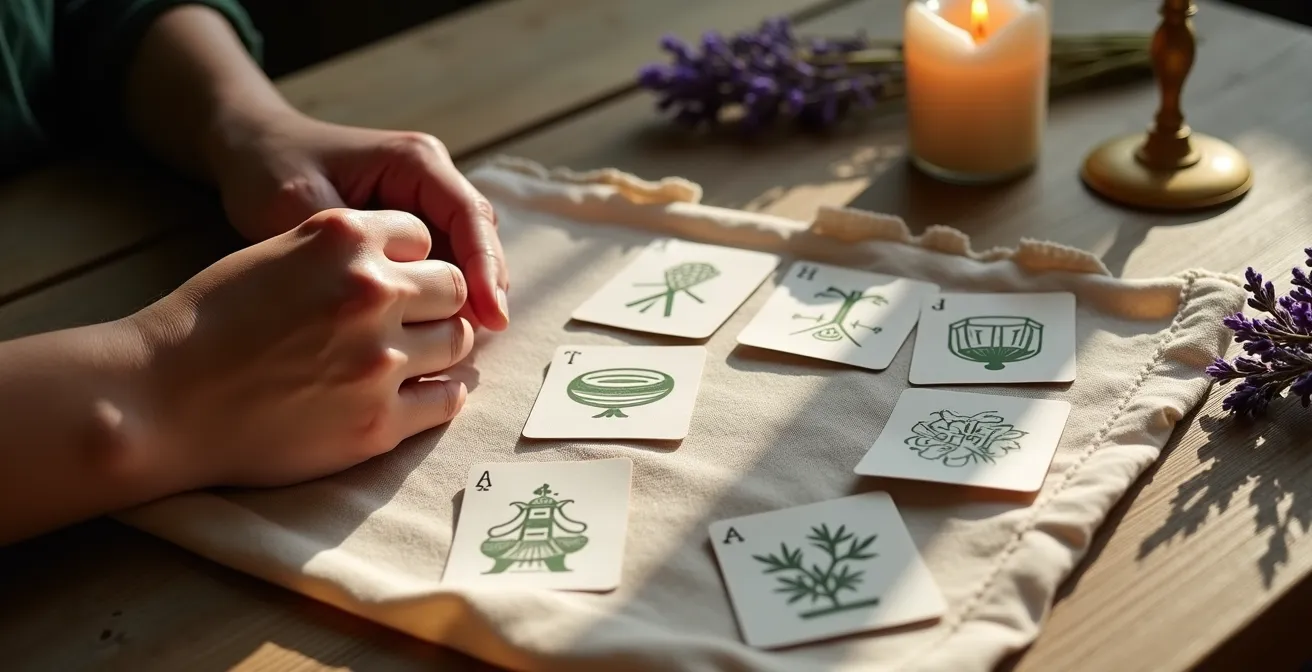
The non-illustrated pip cards of the Tarot de Marseille are not a barrier for beginners, but a deliberate feature that creates a more accurate and deeply intuitive reader.
- This system forces a “grammar-based” learning approach, teaching you the language of Tarot instead of having you memorize a “phrasebook” of scenic images.
- Techniques unique to the Marseille tradition, such as the “Law of the Gaze,” emerge from this visual logic, allowing for interpretations of a depth not possible with pre-canned meanings.
Recommendation: Shift your mindset from trying to ‘see’ a story in the cards to learning the ‘language’ that allows you to construct it with precision.
For the aspiring tarot reader, the first encounter with a Tarot de Marseille (TdM) deck can be intimidating. Where the popular Rider-Waite-Smith (RWS) system offers a full, illustrative scene on every card, the Marseille presents its Minor Arcana with stark, abstract arrangements of suit symbols. This lack of imagery is often misinterpreted as a limitation, a void to be filled, leading many beginners to believe the deck is too “advanced” or “difficult.” This is a fundamental misunderstanding of the deck’s purpose and power.
The truth is precisely the opposite. The “emptiness” of the Marseille pips is not a flaw to be overcome but a feature to be embraced. It is a pedagogical tool of profound genius. As a cartomancer with a deep respect for tradition, I argue that this very feature makes the Tarot de Marseille the most rigorous, and ultimately the most accurate, foundational system for any serious student. It does not hand you answers on a platter; it teaches you the grammar of the Tarot itself. It forces you to move beyond passive interpretation of a pre-drawn picture and engage in the active, logical construction of meaning. After more than 20 years of using tarots based upon the Waite Colman-Smith, my tarot readings took a quantum leap in depth and power when I discovered the TdM. This guide is designed to reframe your perspective and demonstrate why this historical system is the superior starting point for building true, lasting intuitive skill.
This article will deconstruct the core principles of the Marseille system, showing how its unique structure cultivates a deeper form of intuition. We will explore the visual logic of the cards, compare its learning methodology to other systems, and provide a clear path for engaging with this powerful tradition.
Summary: Why the Tarot de Marseille is a superior system for foundational readings
- Why Pips Without Scenes Force Better Intuitive Connection?
- How to Use Character Gaze to Determine Timelines?
- Marseille or Rider-Waite: Which Structure Suits You Best?
- The Mistake of Relying on Keywords Instead of Visual Logic
- How to Order the Majors to Tell a Complete Life Story?
- The Mistake of Assigning Court Cards to Specific People Only
- Birth Day or Full Name: Which Defines Character More?
- Major Arcana Analysis: Decoding the Soulmate Connection
Why Pips Without Scenes Force Better Intuitive Connection?
The core difference and primary point of contention for beginners is the Marseille’s non-scenic pip cards. An RWS Seven of Swords shows a figure stealing swords, immediately suggesting themes of theft or deception. A Marseille Seven of Swords simply shows seven swords arranged in a specific pattern. The common critique is that the former is “easier to read.” This confuses ease with depth. The RWS approach encourages a “phrasebook” method: you see the picture, you recall the associated keyword. The Marseille, however, demands a “grammar” approach.
You are forced to combine two fundamental elements: the numerological value of the card (the “adjective,” e.g., the challenge and mastery of Seven) and the elemental energy of the suit (the “noun,” e.g., the intellectual, conflict-oriented nature of Swords). This active combination—Seven of Swords becomes “a challenge in the mental realm” or “mastery over a conflicting thought”—creates a meaning that is both personal and contextually relevant to the spread. It builds what can be called systemic intuition: an intuitive “hit” that arises not from a random feeling, but from a deep, ingrained understanding of the system’s internal logic.
This process is supported by modern learning principles. By removing the complex, subjective scenes, the Marseille deck reduces the initial cognitive load on the learner. Research in education shows that an overloaded working memory is a primary barrier to deep learning. A 2024 analysis of cognitive load theory research confirmed that 87.5% of studies used experimental methods to demonstrate how simplifying initial inputs leads to better structural understanding. The Marseille pips do exactly this; they strip away the distracting “story” so you can learn the fundamental language first. Only then can you begin to tell your own stories with the cards, rather than repeating one you were shown.
How to Use Character Gaze to Determine Timelines?
One of the most elegant proofs of the Marseille’s “visual logic” is the interpretive method known as the *Loi du Regard*, or the Law of the Gaze. This is a technique that is largely lost or irrelevant in RWS-style decks, where characters often look out at the viewer or in directions that serve the card’s standalone illustration. In the Marseille tradition, the direction a character faces is a crucial piece of syntactical information. It dictates the flow of energy and narrative through a spread.
The principle is simple yet profound: cards “speak” to the cards they are “looking at.” A character facing to the right is generally looking toward the future or the outcome of the spread. A character facing left is looking to the past or the root cause of the issue. A character looking straight ahead engages directly with the querent or the present moment. This allows the reader to create “sentences” with the cards. For instance, if The Empress (looking right) is followed by The Chariot (also looking right), she is looking toward the successful action of the Chariot, suggesting her creative energy is fueling a future victory.
The following diagram illustrates the different directional possibilities within the Major Arcana, forming the basis of this narrative technique.

This method transforms a static line of cards into a dynamic, interacting tableau. It provides a logical framework for determining sequence, cause and effect, and psychological focus (past-dwelling vs. future-oriented). It is a perfect example of deriving sophisticated meaning directly from the image’s structure, rather than from a memorized keyword.
Case Study: Camoin’s Codification of the Law of the Gaze
The restoration work by Philippe Camoin and Alexandre Jodorowsky on their TdM version brought renewed attention to these “secret codes.” Camoin developed a structured reading method based on the Law of the Regard, where the direction of a card’s gaze indicates the narrative flow. This, combined with his “Law of the Solution” (where one card in the spread reveals the resolution), allows a reader to construct complex sentences and stories from the cards’ interactions, proving that the Marseille deck contains its own rigorous, internal logic.
Marseille or Rider-Waite: Which Structure Suits You Best?
The choice between the Marseille and Rider-Waite-Smith systems is not a question of which is “better” in a vacuum, but which learning philosophy better suits your goal as a reader. Do you wish to learn a phrasebook or master a grammar? The RWS system, with its illustrated minors, excels as a phrasebook. Each card is a pre-packaged concept, making it immediately accessible and intuitive for many. This is why most educational materials reference RWS symbolism, creating a dominant market presence that can make the Marseille path seem obscure.
However, for the student who wishes to understand the *why* behind the what—the deep structure of the Tarot—the Marseille system offers a more rigorous and ultimately more versatile foundation. It teaches you the components of meaning so you can assemble them in infinite, nuanced ways. The RWS gives you a fish; the TdM teaches you how to fish. The initial learning curve may be steeper, but the long-term payoff is a reader who is not dependent on a specific artist’s interpretation of a card.
This fundamental difference in approach is the most critical factor to consider when choosing your foundational deck. The following table breaks down the two philosophies across several key aspects.
| Aspect | Marseille Tarot | Rider-Waite-Smith |
|---|---|---|
| Minor Arcana Style | Abstract pip cards | Fully illustrated scenes |
| Learning Approach | Grammar-based system | Phrasebook memorization |
| Intuitive Development | Forces personal interpretation | Provides ready-made meanings |
| Historical Period | 14th-18th century tradition | Early 20th century occult |
| Major Arcana Structure | 3×7 numerical system | Individual archetypes |
Ultimately, the “best” deck is the one that aligns with your personal learning style and long-term goals. If you seek immediate, accessible imagery, the RWS is an excellent tool. If you seek to build a deep, systemic, and portable understanding of Tarot’s language, the Marseille is the unmatched master.
The Mistake of Relying on Keywords Instead of Visual Logic
The most common pitfall for any Tarot student, regardless of the deck they use, is an over-reliance on memorized keywords. This habit, however, is actively encouraged and enabled by the RWS system’s scenic pips. The picture dictates a narrow range of acceptable meanings. As one reader wisely noted in a forum discussion, while one might think RWS allows for greater interpretation, “what actually happens, is that it narrows your interpretation down to what can be gained from the one image.” The Marseille system, by its very design, breaks this dependency.
It forces the reader to engage with visual logic. This is the art of deriving meaning from the card’s composition: the number, the suit, the geometric arrangement of the suit elements, and its interaction with other cards. Is the arrangement of cups open and flowing, or closed and static? Are the swords crossing in conflict, or arranged in a defensive pattern? These are not arbitrary artistic choices; they are the syntax of the card’s message. The pips are not blank slates; they are intricate diagrams of energy.
Relying on keywords is like trying to navigate a city with a list of street names but no map. You know the names, but you have no understanding of how they connect. Visual logic is the map. It shows you the relationships, the pathways, and the overall structure. It allows you to navigate any reading with confidence because you are not just recalling facts; you are understanding the system itself.
Your Action Plan: Applying the Visual Syntax Method
- Identify Core Components: For any given pip card, first state its number (the quality or intensity, like an adjective) and its suit (the subject or action, like a noun). Example: “This is a dynamic five (adjective) of the material realm (noun).”
- Analyze Geometric Structure: Observe the arrangement of the suit symbols. Is it a stable, closed structure (like a Four of Coins) suggesting security or stagnation? Or is it an open, dynamic pattern (like a Five of Wands) suggesting change or conflict?
- Synthesize a Base Meaning: Combine the number, suit, and geometry into a core concept. Example: “A dynamic five in the material realm, arranged in an unstable pattern, points to a disruption or change in financial or physical security.”
- Contextualize with Position: Consider the card’s position in the spread as its grammatical role. Is it in the “past” position, defining the cause? Or the “future” position, defining the outcome?
- Refine with Dignities: Observe the surrounding cards. How do they interact? For Court Cards, apply elemental dignities (e.g., Fire and Water clashing) to see how the energies are being managed or mismanaged.
How to Order the Majors to Tell a Complete Life Story?
While the pip cards form the grammar of the Tarot, the 22 Major Arcana or Trumps represent the great archetypal forces and the universal journey of the soul. In the Marseille tradition, this journey is not just a random sequence of powerful images but a highly structured narrative of human development. One of the most insightful ways to understand this is through the 3×7 structure, a system of organization popularized by thinkers like Alejandro Jodorowsky.
This framework divides the first 21 Trumps (The Fool is often seen as separate, initiating the journey) into three distinct tiers of seven cards each:
- Tier 1 (Cards 1-7): This represents the earthly, active journey of the ego. It is about learning to act in the world, from the initial potential of The Magician to the worldly success and control of The Chariot. It is the realm of doing, achieving, and building a foundation in the material world.
- Tier 2 (Cards 8-14): This tier represents the inward, passive journey of the soul. It begins with Justice (or Strength, depending on the system), a moment of reckoning and turning inward. This path explores deeper, more receptive energies, culminating in Temperance, a card of integration and alchemy. It is the realm of feeling, receiving, and integrating life’s lessons.
- Tier 3 (Cards 15-21): This represents the celestial, spiritual journey towards cosmic consciousness. It starts with the confrontation of our deepest shadows in The Devil, moves through radical transformation, and ends with the total integration and liberation of The World. It is the realm of being, transcending, and realizing our connection to the whole.
This three-tiered structure transforms the Major Arcana from a collection of powerful archetypes into a coherent map of spiritual and psychological development.
Seeing the Majors through this lens provides a powerful diagnostic tool in a reading. A predominance of cards from the first tier might indicate a focus on worldly matters, while a cluster from the third tier could point to a major spiritual transformation. It is another layer of the deck’s profound and logical elegance.
The Mistake of Assigning Court Cards to Specific People Only
A common but limiting practice, especially among beginners, is to interpret the sixteen Court Cards solely as literal representations of people in the querent’s life. The King of Swords becomes “your boss,” the Queen of Cups becomes “your mother,” and the Page of Wands becomes “a creative young person.” While Court Cards can certainly represent people, this one-to-one mapping barely scratches the surface of their true function, especially within the rigorous Marseille system.
A more sophisticated and accurate approach is to view the Court Cards as “Energy Regulators.” They describe *how* the energy of a suit is being managed, embodied, or expressed. They are adverbs as much as they are nouns. They represent levels of maturity and mastery over a suit’s domain.
- The Page (Valet): Represents the nascent, exploratory energy of a suit. It is the spark, the student, the apprentice. It is about learning and initial discovery.
- The Knight (Cavalier): Embodies the active, outward-moving energy of a suit. It is the doer, the messenger, often extreme and unbalanced. It is about action and momentum.
- The Queen (Reine): Represents the inward mastery and understanding of a suit’s energy. It is the receptive, nurturing, and internal authority. It is about being and knowing.
- The King (Roi): Signifies the outward, mature command of a suit’s energy. It is the external authority, the leader, who directs the suit’s power in the world. It is about ruling and executing.
Viewing them this way, a King of Swords in a reading may not be a specific person at all, but rather the need for the querent to embody mature, objective, and authoritative thinking in a situation. As one advanced teaching perspective puts it, the Court Cards show “how the raw energy of the surrounding pip cards is being managed.” They are the characters who wield the energies described by the numbered pips, giving a reading psychological depth and strategic direction.
Birth Day or Full Name: Which Defines Character More?
The Tarot de Marseille’s systemic nature finds a natural resonance with the ancient art of numerology. While RWS-based numerology often relies on complex Golden Dawn attributions, the Marseille tradition offers a more direct and elegant correspondence. This connection is not about fortune-telling but about identifying the core archetypal energies that a person is working with in their lifetime. Both birth date and full name can be used, but the birth date is generally considered the foundational number, defining the “Life Path.”
The most common and effective system connects the single-digit numbers (1-9) and the master numbers (11, 22) to their corresponding Major Arcana cards. This creates a powerful bridge between your personal numerological blueprint and the universal archetypes of the Tarot. For example, a person with a Life Path Number 1 (calculated from their birth date) is intrinsically linked to the archetype of The Magician (I). Their life’s work revolves around themes of creation, manifestation, and channeling potential into reality.
This system provides a profound starting point for self-inquiry with the cards. Your Life Path card is not a static descriptor but a dynamic theme. The pip cards in a reading can then show how that core theme is manifesting in daily life. For a Life Path 7 (The Chariot), a Four of Coins might indicate that their drive for success is currently focused on building material security, while a Ten of Swords might show that their path to mastery is blocked by a painful mental ending.
Numerology in Practice: The Major Archetypes
The core of the TdM numerology system utilizes the first ten Major Arcana as the primary archetypes for the numbers 1 through 10. This direct correspondence allows for fluid interpretation. For instance, the number 7 is not just an abstract concept of victory or spirituality; it is embodied by The Chariot. Therefore, any 7 in the deck (7 of Cups, 7 of Swords, etc.) carries a faint echo of The Chariot’s energy—the drive to achieve success through mastery and the harnessing of opposing forces. This creates a rich, interconnected web of meaning that makes the entire deck feel like a coherent whole.
Key Takeaways
- The Tarot de Marseille’s non-scenic pips are a feature, not a bug, designed to teach the “grammar” of Tarot over “phrasebook” memorization.
- Advanced techniques like the “Law of the Gaze” demonstrate the system’s reliance on visual logic and card interaction, rather than isolated keywords.
- The Marseille system is not “harder” but more rigorous, offering a deeper, more versatile understanding of Tarot’s structure for the serious student.
Major Arcana Analysis: Decoding the Soulmate Connection
Nowhere is the philosophical difference between the Marseille and RWS traditions more apparent than in the Major Arcana, specifically with card VI. In most modern decks, this card is “The Lovers,” typically depicting a man, a woman, and an overseeing angelic figure, symbolizing union, harmony, and partnership. In the Tarot de Marseille, however, the card is titled L’Amoureux—The Lover, in the singular. This is not a trivial distinction; it is a profound shift in meaning.
The classic Marseille image for L’Amoureux shows a young man standing between two women, with a Cupid-like figure aiming an arrow from above. The card’s primary energy is not one of union, but one of choice. The man is at a crossroads, facing a critical decision, often between virtue and vice, or the familiar and the unknown. The “soulmate connection” here is not with another person, but the connection to one’s own values and path that is forged *through* the act of making a difficult choice. It is a card of alignment with oneself before it is about alignment with another.
This specificity is a hallmark of the Marseille system. As a tradition that is hundreds of years older than its modern offshoots, its symbolism is often more direct and less romanticized. The RWS “Lovers” card provides a comforting, pre-packaged answer about union. The Marseille “L’Amoureux” asks a more difficult and more fundamental question: “What do you choose?” It forces the querent to engage with their own agency, which is a far more powerful and transformative reading experience. It teaches that the most important connection we must make is the one with our own authentic path.