
Getting reliable answers from a pendulum isn’t about magic, but about mastering the ideomotor response—the physical expression of your subconscious knowledge.
- Key steps include correctly programming its signals for “Yes” and “No”, choosing a material that resonates with your energy, and ensuring you are in a neutral state before each session.
- Accuracy improves dramatically by treating dowsing as a skill of self-communication, not a psychic reading.
Recommendation: Start with the ‘Knowns Calibration Method’: ask 5-10 questions with verifiable answers daily to build trust and accuracy in your pendulum’s unique movements.
If you’ve ever held a pendulum, you’ve likely felt a mix of curiosity and skepticism. You ask a question, and it swings, seemingly of its own accord. The common advice is to simply “trust the energy” or “connect with your higher self,” but for a beginner, this can feel vague and lead to inconsistent, frustrating results. You might wonder if you’re just imagining it, or worse, influencing the outcome with your own hopes and fears. This uncertainty is the biggest hurdle to overcome when starting your dowsing journey.
The truth is that reliable dowsing is far less about mystical forces and far more about a tangible, repeatable process. The secret doesn’t lie in the pendulum itself, but within your own body. What if the key to getting clear, trustworthy answers wasn’t about channeling an external energy, but about learning to listen to the subtle signals your own subconscious mind is already sending? This guide reframes dowsing from a mysterious art into a practical skill of self-communication.
Instead of hoping for a magical connection, we will focus on a systematic approach: calibrating your nervous system as a precise instrument. We will explore the science behind the swing, the importance of choosing the right tool for the job, and the pre-session rituals that ensure your answers are coming from a place of pure intuition, not emotional bias. This article will walk you through the essential steps to transform your pendulum from an unpredictable object into a reliable extension of your own inner wisdom.
This comprehensive guide is structured to take you from foundational understanding to practical application. Below is a summary of the key areas we will cover, designed to build your skills and confidence step by step.
Summary: A Beginner’s Guide to Pendulum Calibration
- Why Your Micro-Movements Are Actually Your Subconscious Speaking?
- How to Program Your Pendulum for “Yes”, “No”, and “Maybe”?
- Wood, Metal, or Crystal: Which Material is Best for Beginners?
- The Error of Dowsing When You Are Tired or Dehydrated
- How to Use Dowsing Charts for More Than Just Yes/No?
- Raw Stone or Tumbled Gem: Which Holds Purest Energy?
- Why Alpha and Theta States Are Crucial for Intuition?
- How to Read Energy Fields Using a Dowsing Rod or Pendulum?
Why Your Micro-Movements Are Actually Your Subconscious Speaking?
The most significant revelation for any new dowser is understanding that the pendulum isn’t moving by itself. The motion originates from the ideomotor response: tiny, unconscious muscle movements in your fingers and hand. These are not random twitches; they are direct, physical manifestations of your subconscious mind. When you ask a question, your deeper knowing formulates an answer, which then travels through your nervous system, causing micro-contractions that create a visible, readable swing. You are not receiving a message from an external spirit; you are reading a printout from your own internal database.
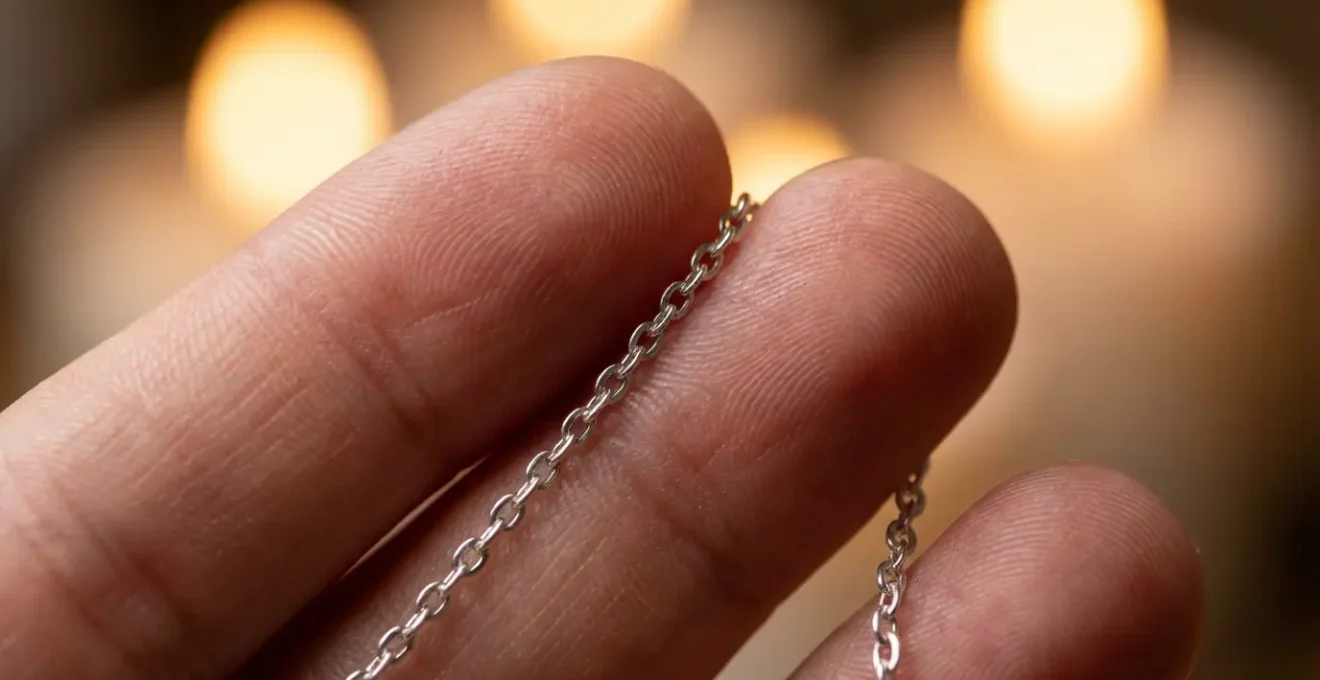
This concept is the foundation of reliable dowsing. It shifts the focus from “Is this magic?” to “How clear is my signal?” The image below illustrates how this subtle connection works. The chain is not just a string; it’s a conduit for neuromuscular signals originating from your brain.
Recognizing this mechanism is empowering. It means you have control. However, it also introduces a critical challenge: differentiating a true subconscious signal from conscious interference or “wishful thinking.” Your conscious mind, with its hopes, fears, and biases, can easily hijack the ideomotor response. The primary skill of a dowser is to become a neutral observer, creating a clear channel for the subconscious to speak without interruption. The following checklist is designed to help you audit the source of your pendulum’s movements.
Action Plan: Differentiating True Intuition from Wishful Thinking
- Test with Known Neutrals: Before your main query, ask 5 simple questions with verifiable, emotion-free answers (e.g., “Is my name [Your Name]?”, “Is it currently daytime?”). This establishes your baseline response pattern for that session.
- Monitor Your Emotional State: Before asking a significant question, rate your emotional attachment to the outcome on a scale of 1-10. If your rating is above a 7, your desire for a specific answer is likely to interfere. Perform grounding exercises first.
- Cross-Check with the ‘Opposite Test’: After receiving an answer, clear your mind and deliberately think the *opposite* answer while holding the pendulum. If the movement changes to reflect your conscious thought, it indicates that emotional interference is high.
How to Program Your Pendulum for “Yes”, “No”, and “Maybe”?
A pendulum is like an unformatted hard drive; it holds potential but is useless without a clear operating system. “Programming” is the simple but crucial process of assigning specific movements to specific answers. This creates a consistent language between your subconscious mind and the physical tool. Without this step, any movements are just random noise. The most common method is the “Knowns Calibration,” a daily ritual that reinforces the connection. As documented by Satin Crystals practitioners, this involves asking 5-10 verifiable questions each morning, such as “Is today Monday?” or “Am I wearing a blue shirt?” This two-minute practice establishes empirical baselines unique to each session, dramatically increasing confidence and accuracy.
To begin, hold your pendulum and ask it, “Please show me my ‘Yes’.” Wait patiently for a consistent movement to emerge. This might be a forward-and-backward swing, a clockwise circle, or something else entirely. Once it’s established, stop the pendulum and say, “Thank you. This is my ‘Yes’.” Repeat the process for “No” (often the opposite movement) and for a third signal like “Maybe” or “Question is unclear” (perhaps a different circular motion or a diagonal swing). This deliberate assignment is what makes communication possible.
While a basic Yes/No/Maybe setup is sufficient for most beginners, understanding a wider range of signals can provide more nuanced feedback. As you become more experienced, your subconscious may develop more sophisticated responses to indicate the quality of the question itself. The table below, based on insights from dowsing experts, outlines some advanced signals that can develop over time. This data, presented in a comparative analysis by professional dowsers, helps you interpret more complex movements.
| Signal Type | Common Movement | Purpose | When to Use |
|---|---|---|---|
| Yes | Back-and-forth (vertical) | Affirmative response | Clear binary questions |
| No | Side-to-side (horizontal) | Negative response | Clear binary questions |
| Maybe/Unclear | Circular (clockwise) | Uncertain or developing | When timing is not fixed |
| Rephrase Question | Diagonal swing | Question poorly formed | Complex or vague queries |
| Not Available | No movement/trembling | Information restricted | Questions about the future or others |
| Ask Later | Elliptical motion | Timing inappropriate | Premature or sensitive questions |
Wood, Metal, or Crystal: Which Material is Best for Beginners?
The material of your pendulum isn’t just an aesthetic choice; it influences the quality and “feel” of the signal. For a beginner, the goal is clarity and consistency. Some materials are naturally “louder” or more “neutral” than others, which can be a significant advantage when you’re first learning to tune into the ideomotor response. There is no single “best” material, but there is a “best” material for *you*. Your selection should be based on your energetic sensitivity and the type of feedback you find easiest to read.
Crystal pendulums are popular, but their specific energetic properties can sometimes add a layer of complexity. A metal or wood pendulum often provides a more direct, unfiltered signal, which is ideal for a beginner focused solely on mastering Yes/No answers. Consider the following points when making your choice:
- Wood Pendulum: Choose this if you are grounded, prefer a neutral energy, or find yourself highly sensitive to crystal vibrations. Oak offers stability, while willow provides flexibility.
- Metal Pendulum (Brass/Copper): An excellent choice for analytical minds who want clear, strong, and consistent signals without any perceived energetic “noise.” Brass is a great neutral conductor, while copper is known for its high conductivity.
- Clear Quartz Crystal: If you are drawn to crystals, clear quartz is the ideal starting point. It acts as a “blank slate” and an amplifier, adapting to your energy without imposing its own strong properties.
- Weight and Shape: Regardless of material, prioritize a symmetrical, pointed shape for the clearest directional readings. A weight between 15-30 grams is optimal for most people, creating smooth swings without causing arm fatigue.
Ultimately, personal resonance plays a key role. As experts from the Holistic Shop’s dowsing guide explain, the connection is crucial:
The type of pendulum you choose depends in part on what feels right for you. Many people choose to use a crystal pendulum. Clear quartz, for example, is a popular choice, as the crystal is associated with clarity and connecting to a higher purpose.
– Holistic Shop UK, Pendulum Dowsing Guide
Remember that materials like crystals may absorb ambient energy, so a simple cleansing ritual (like leaving it in moonlight or smudging with sage) can be beneficial to reset its neutrality before a session.
The Error of Dowsing When You Are Tired or Dehydrated
One of the most common reasons beginners get confusing or “wrong” answers from their pendulum is a failure to prepare their own physical and emotional state. Because the pendulum’s movement is a direct result of your nervous system, its accuracy is intrinsically linked to your well-being. Dowsing when you are tired, stressed, emotionally invested, or even just dehydrated is like trying to use a sensitive scientific instrument during an earthquake. The “signal” will be corrupted by “noise.”
Dehydration, for example, directly impacts your body’s electrical conductivity, making the subtle neuromuscular signals of the ideomotor response weak and erratic. Fatigue and stress create physical tension in your arm and shoulder, which can override the delicate subconscious movements with larger, more random jerks. This is often the answer to the question, “Can a pendulum be wrong?” The pendulum is rarely wrong; it is simply reflecting the noisy, unclear state of its operator. Energetic hygiene—the practice of neutralizing your physical and emotional state—is not an optional step; it is a prerequisite for accuracy.
Before every dowsing session, no matter how brief, you should perform a quick self-assessment. Think of it as a pilot’s pre-flight checklist. This simple routine ensures your instrument (your body) is properly calibrated and ready to receive clear signals. The following checklist will help you prepare for a successful session.
- Hydration Check: Have you had a glass of water in the last 30 minutes? Your body needs water to conduct the subtle electrical signals from your brain to your hand.
- Emotional Neutrality: Are you heavily invested in a particular outcome? If so, your conscious desire can override your subconscious intuition. Take a moment to breathe and mentally state your willingness to accept any answer.
- Physical Relaxation: Roll your shoulders, shake out your hands, and release any tension in your arm. A tense body cannot transmit the micro-movements needed for a clear swing.
- Grounding: Take a moment to feel your feet on the floor. Visualize roots extending from your soles into the earth. This simple mental exercise helps to discharge nervous energy and stabilize your own energy field.
How to Use Dowsing Charts for More Than Just Yes/No?
While Yes/No questions are the foundation of dowsing, their binary nature can be limiting. What if you need to choose between multiple options, determine a percentage, or identify a specific item from a list? This is where dowsing charts become an invaluable tool. A dowsing chart is simply a diagram with pre-defined fields that your pendulum can select. Instead of a simple “Yes” or “No” swing, the pendulum will swing directionally, pointing towards the most appropriate answer on the chart.
This method dramatically expands the scope and nuance of your dowsing practice. For example, practitioners at the Wicca Academy have documented a powerful use case with percentage charts. By using a semicircular chart labeled from 0% to 100%, they can transform a vague “Maybe” into a quantifiable insight. A swing towards “80%” might indicate a project is nearly ready, while a swing to “30%” suggests it needs significant work. This provides actionable data far beyond a simple binary response.
Creating your own custom charts is a simple yet powerful way to tailor your dowsing practice to your specific, recurring needs. You don’t need elaborate designs; a simple hand-drawn chart on a piece of paper is perfectly effective. The key is to clearly define the options so your subconscious has a clear “menu” to choose from.
- Identify Your Question Category: Start by thinking about the types of questions you ask frequently. Common categories include health (e.g., vitamins, foods), decisions (e.g., Career A, B, or C), or timing (e.g., days of the week, months).
- Design the Layout: Draw a semicircle or a full circle on a piece of paper. A semicircle is often easier for beginners to read as the swing is more distinct. Divide it into as many sections as you need options (typically 4-12).
- Label the Sections: Clearly write one option in each section. For example, a “Vitamin” chart might have sections for “Vitamin C,” “Vitamin D,” “B Complex,” “Iron,” and “None Needed.”
- Calibrate the Chart: Before its first real use, test the chart with a known answer. Hold your pendulum over the center and ask a question you already know the answer to, to confirm the pendulum swings accurately towards the correct field.
- Laminate for Durability: If you create a chart you use often, consider laminating it. This not only makes it more durable but also gives it a consistent energy signature that your subconscious can recognize more easily.
Raw Stone or Tumbled Gem: Which Holds Purest Energy?
When choosing a crystal pendulum, you’ll face a fundamental choice: a raw, natural stone or a smooth, tumbled gem. While they may be the same mineral, their shape and finish dramatically alter their energetic behavior and, consequently, how they perform as a dowsing tool. This choice is particularly important for a beginner, as it directly impacts the readability of the pendulum’s swing. One is not inherently “better,” but they serve very different purposes.
A raw stone maintains the original, untamed energy of its formation. Its energy field is often described as powerful and vast, but also chaotic and multi-directional. This can be potent for advanced energy work or deep spiritual connection, but for the clear, binary answers a beginner seeks, this “wild” energy can create erratic or hard-to-read swings. Its irregular shape can also lead to an unbalanced swing path, adding physical noise to the intuitive signal.
A tumbled stone, by contrast, has been polished and shaped, which focuses its energy. As experts at Crystal Life Technology note, this process transforms the stone’s output.
Raw stones have a chaotic, powerful, ‘wild’ energy field, potent but potentially scattered. Tumbled stones have been polished, focusing their energy into a smooth, stable, and more directed beam, often better for the clear Yes/No answers a beginner seeks.
– Crystal Life Technology, Crystal Pendulum Selection Guide
This focused energy, combined with a symmetrical and balanced shape, results in a pendulum that provides a much smoother, more predictable, and easier-to-read swing. This makes it the superior choice for beginners focused on mastering the fundamentals. The following table provides a clear comparison based on practical analysis from crystal specialists.
| Aspect | Raw Stone | Tumbled Stone | Best For |
|---|---|---|---|
| Energy Pattern | Chaotic, multi-directional | Focused, streamlined | Raw: Deep spiritual work Tumbled: Clear answers |
| Swing Path | Erratic, harder to read | Predictable, smooth | Tumbled for beginners |
| Structural Integrity | May have weak points | Uniformly strong | Tumbled for durability |
| Energy Intensity | High, unfiltered | Moderate, refined | Raw for experienced users |
Why Alpha and Theta States Are Crucial for Intuition?
The ability to receive a clear intuitive signal depends on quieting the loud, analytical chatter of your conscious mind. This isn’t just a spiritual concept; it’s a neurological one. Your brain operates at different frequencies, or “states.” Your everyday waking consciousness, full of lists, worries, and logical analysis, is the Beta state. While essential for navigating the world, it’s the enemy of clear dowsing. True intuition arises from the quieter, more receptive brainwave states: Alpha and Theta.
The Alpha state is a state of relaxed awareness, like when you’re daydreaming or lightly meditating. The Theta state is even deeper, associated with deep meditation, REM sleep, and profound creative insight. In these states, the “noise” of the conscious mind fades, allowing the subtle signals from the subconscious to emerge without interference. This is why dowsing requires a moment of intentional mental preparation. You need to consciously shift your brain out of Beta and into Alpha. This is the practical “how-to” behind the generic advice to “clear your mind.” In fact, interesting Oxford neuroscience research indicates that women often produce larger ideomotor movements than men, suggesting potential differences in how these intuitive signals are processed and expressed physically across populations.
Fortunately, inducing an Alpha state doesn’t require hours of meditation. A simple, three-minute routine is enough to downshift your brainwaves and create a clear channel for dowsing. Practice this before every session:
- Minute 1: Soft-Focus Gazing. Hold your pendulum and look at it, but intentionally soften your focus. Let your vision blur slightly. This simple act naturally disengages the analytical part of your brain and encourages a shift from Beta to Alpha.
- Minute 2: Box Breathing. Inhale slowly for a count of four, hold your breath for four, exhale for four, and hold the empty breath for four. Repeat this cycle four to five times. This technique synchronizes your heart rate and nervous system, calming the body’s stress response.
- Minute 3: Pendulum Meditation. While keeping your hand perfectly still, simply *imagine* the pendulum making its “Yes” swing. Then imagine its “No” swing. This primes the neuromuscular pathways of the ideomotor response, making your physical tool more responsive to your subconscious commands.
Key Takeaways
- Reliable dowsing is a physical skill based on the ideomotor response, not a mystical power.
- Consistent daily calibration with known answers is the fastest path to accuracy.
- Your physical and emotional state (hydration, neutrality) is more important than the pendulum itself.
How to Read Energy Fields Using a Dowsing Rod or Pendulum?
Once you have mastered obtaining clear Yes/No answers, you can begin to explore one of the more subtle applications of dowsing: reading energy fields. This is not about seeing auras, but about detecting and interpreting changes in the energy that surrounds people, places, or objects. Your pendulum acts as a biofeedback device, and its swing can provide information about the state of an energy field—be it strong, weak, blocked, or flowing. The key to this practice is establishing a clear personal baseline first.
Experienced radiesthesia practitioners document a method of establishing this baseline by first dowsing their own energy field when they are feeling calm, healthy, and centered. This is their “healthy swing” pattern. For many, this is a smooth, clockwise circle of about 2-3 inches in diameter when the pendulum is held over their solar plexus or the palm of their hand. This pattern becomes the reference point. Any deviation from this baseline when dowsing another person or a space indicates a change in energy. For instance, a jerky or erratic movement might suggest an energetic blockage, a very small or weak swing could indicate energy depletion, and a chaotic swing might point to external interference.
With this baseline established, you can begin to practice on other things. Hold your pendulum over a healthy houseplant and observe the swing. Then, hold it over a wilted one and note the difference. You can do the same with different foods, crystals, or even physical spaces in your home. This is a process of building an experiential library of what different energetic signatures “feel” like through your pendulum. It’s about moving from asking direct questions to engaging in a more passive, observational form of dowsing where you are simply sensing and interpreting the quality of the swing itself.
By following these practical, step-by-step methods, you demystify the process and empower yourself with a tool for clear insight. The journey begins now. Start today by choosing your tool, programming its language, and committing to the simple daily calibrations that build the bridge to your subconscious wisdom.
Frequently Asked Questions about Dowsing with a Pendulum
Can a pendulum be wrong?
The pendulum itself is rarely “wrong”; it is a neutral amplifier of your body’s signals. Inaccurate answers almost always stem from the operator. The most common causes are emotional attachment to a specific outcome (“wishful thinking”), physical fatigue, dehydration, or asking poorly phrased questions. Ensuring you are in a neutral, grounded state is the best way to guarantee accuracy.
What questions should you not ask a pendulum?
Avoid asking questions about the distant future, questions that infringe on another person’s privacy, or questions to which you are not meant to know the answer. A well-programmed pendulum will often give a “Not Available” signal (e.g., no movement) for such queries. It is best used as a tool for self-insight and guidance on your own path, not for predicting events or prying into others’ lives.
How do you cleanse a pendulum?
Cleansing is especially important for crystal pendulums, which can absorb ambient energies. Simple methods include leaving it in the light of a full moon overnight, smudging it with sage or palo santo smoke, placing it on a selenite charging plate, or simply stating a clear intention for it to be cleansed of all external influences and returned to a neutral state.