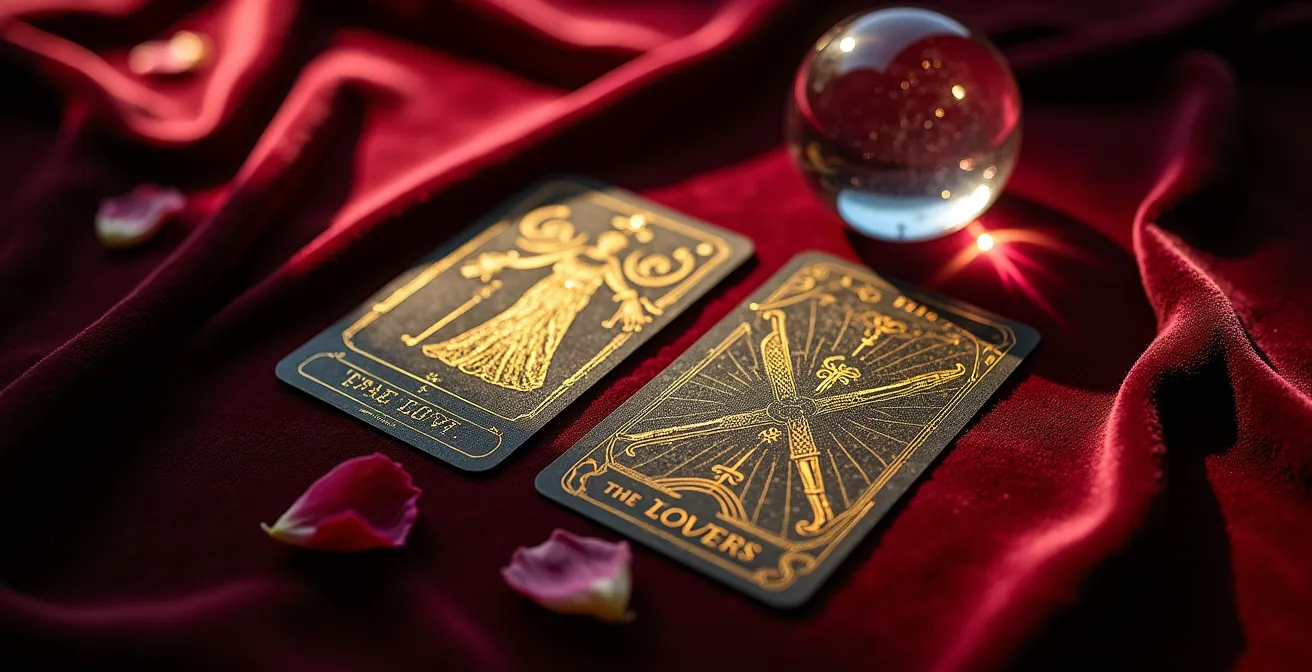
Forget trying to ‘predict’ sexual compatibility; the real power of Tarot and astrology is in decoding the *quality* and *nature* of the desire you already feel.
- Tarot cards like The Devil and The Lovers don’t represent ‘good’ or ‘bad’ lust, but different energetic signatures of desire—primal versus integrated.
- Astrological synastry reveals the core dynamics: Mars acts as the passion ‘engine,’ while the Moon provides the emotional ‘chassis’ required for long-term connection.
Recommendation: Use the frameworks in this guide not to spy on a partner’s feelings, but to understand your own desires and identify the energetic blockages you can clear for deeper intimacy.
That electrifying buzz with someone new—is it just a fleeting spark or the start of a bonfire? In the intoxicating early stages of a relationship, the question of sexual chemistry looms large. We’ve all been there, dissecting every text and glance, trying to gauge the depth of a potential partner’s desire. Mainstream advice tells you to look for body language cues or communication styles, but these only scratch the surface of the powerful, often unseen, energies at play. You might even turn to basic Tarot interpretations, seeing the Devil card and assuming it’s a green light for raw passion.
But what if the key to understanding sexual chemistry wasn’t about simplistic predictions, but about decoding its unique energetic signature? What if the true answer lies in a more nuanced approach, one that looks beyond a single card and explores the dynamic interplay of passion, emotion, and psychological readiness? This guide moves past the clichés. We’ll explore how Tarot can reveal not just the presence of lust, but its specific flavor—differentiating primal urges from conscious, heart-centered connection. We’ll also bridge the gap between the cards and the cosmos, examining how astrological synastry provides the blueprint for that chemistry’s long-term potential.
This is your invitation to become fluent in the language of desire. By learning to identify the archetypes of attraction, recognize energetic blockages, and respect the ethics of energetic inquiry, you can move from a place of uncertainty to one of empowered clarity. You’ll learn not just to ask *if* there’s chemistry, but to understand its quality, its potential, and how to nurture it into something truly satisfying.
This article provides a complete framework for exploring these dynamics. You will discover the specific Tarot indicators of lust, learn how to identify sexual blockages with a targeted spread, and understand the crucial differences in desire represented by major archetypes. We’ll then pivot to the stars to explore the planetary rulers of long-term success and personal satisfaction before bringing it all together with a guide to synastry interpretation.
Summary: Tarot of Desire: Revealing Sexual Chemistry in New Relationships
- Why the Ace of Wands is the Ultimate Indicator of Lust?
- How to Identify Sexual Blockages Using a 5-Card Spread?
- The Devil or The Lovers: Which Indicates Pure Physical Desire?
- The Risk of Reading into Someone’s Private Fantasies Unasked
- When is the Right Time for Intimacy According to the Cards?
- Mars or Moon: Which Planet Dictates Relationship Longevity?
- How to Decode Your Venus Sign to Find True Satisfaction?
- How to Interpret Synastry for Long-Term Relationship Success?
Why the Ace of Wands is the Ultimate Indicator of Lust?
When you’re looking for that raw, undeniable spark of physical attraction in a reading, the Ace of Wands is your neon sign. While other cards hint at desire, this one screams it from the rooftops. It represents the very genesis of passion—a pure, untamed burst of creative and sexual energy. Think of it as the divine lightning bolt that ignites potential. It’s the initial, instinctive impulse, the “I want you now” feeling that precedes thought or emotional analysis. This card signifies a powerful new beginning, specifically one fueled by primal creative force and potent vitality.
The symbolism is direct and potent. The wand itself is often seen as a phallic symbol, representing generative power and forward momentum. However, its meaning is far more inclusive than a literal interpretation. It’s about the universal energy of creation and ambition, a force we can all feel and express regardless of gender or orientation. When this card appears, it confirms the presence of a strong, active, and outward-moving desire. It’s not a passive crush; it’s an energy that wants to *do* something, to create, to connect, to act on its impulse.
Unlike cards that speak to emotional connection or long-term partnership, the Ace of Wands is purely about the initial ignition. It doesn’t guarantee a lasting relationship or even emotional compatibility. Its territory is the exhilarating, and sometimes chaotic, realm of pure, unadulterated lust. Seeing this card is a clear confirmation that a powerful energetic potential for physical connection exists. The question it then poses is: what will you build with this fire?
Embracing this card’s message means acknowledging the power of this initial spark without confusing it for the entire bonfire. It’s the starting gun, not the finish line, and its appearance is an electrifying permission slip to explore that nascent passion.
How to Identify Sexual Blockages Using a 5-Card Spread?
So, the chemistry is there, but something feels… off. The energy is stuck, conversations stall, or the leap to physical intimacy just isn’t happening. Tarot is an exceptional tool for diagnosing these energetic blockages. Instead of asking “Do they desire me?”, a more empowering question is “What is blocking the flow of intimacy between us?” A targeted 5-card spread can illuminate the hidden dynamics, revealing the subtle locks preventing the key from turning.
This kind of reading moves beyond simple fortune-telling into the realm of spiritual diagnostics. You are mapping the energetic landscape of the connection to find points of resistance. These blockages can be internal (your own fears or limiting beliefs), external (situational pressures), or reside within the dynamic itself. The key is to look at the cards not just for their standard meanings, but for their role as signifiers of stuck energy. For example, the Three of Swords could point to a past heartbreak that’s preventing new vulnerability, while the Five of Pentacles might indicate feelings of insecurity or unworthiness that are chilling the passion.
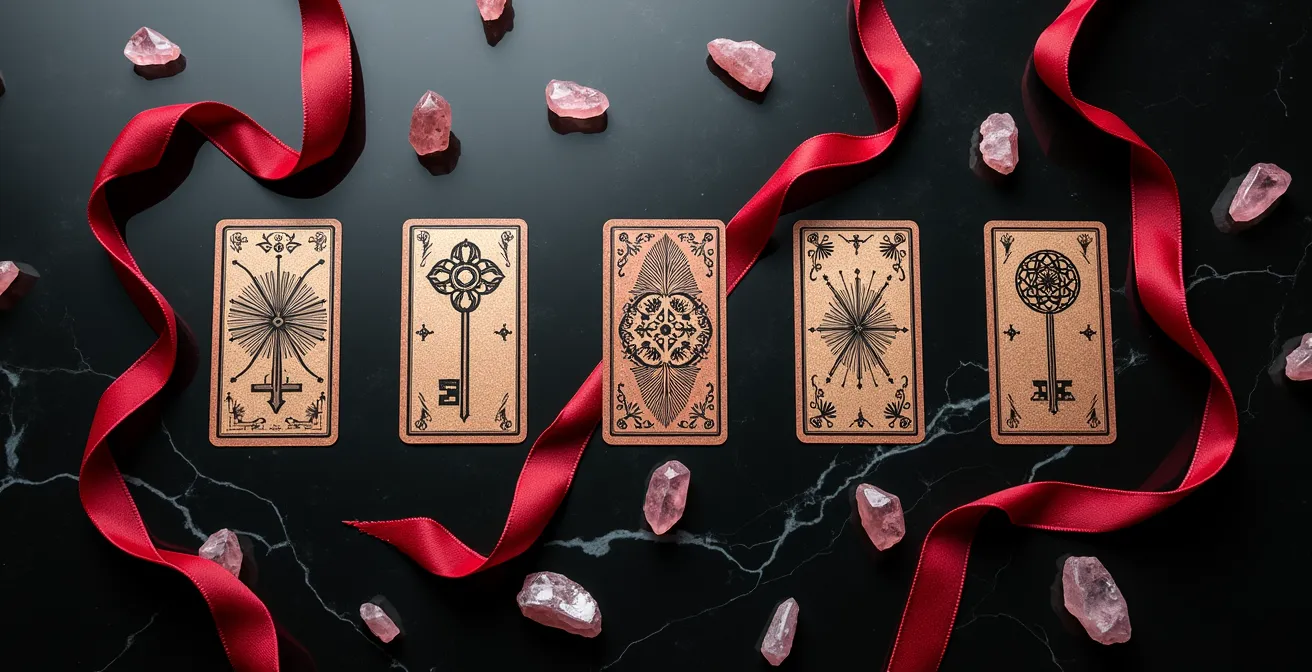
Interestingly, even traditionally “positive” cards can indicate blockages in this context. A recent study of relationship readings highlighted this surprising trend, noting how cards of stability or hope can sometimes represent a fear of disrupting the status quo. For example, a 2026 study of relationship tarot readings found that the Ten of Pentacles often signifies a fear of risking a stable, comfortable life for a more passionate, but less certain, connection. Similarly, The Star can represent an idealistic fantasy that prevents someone from engaging with the messy, real-world reality of intimacy. This reframing is crucial for identifying the subtle psychological barriers that masquerade as contentment.
By using a spread designed to uncover resistance, you shift from a passive role to an active one. You are no longer just a spectator to the relationship’s unfolding but an informed participant who can identify and begin to consciously address the invisible walls between you and a potential partner.
The Devil or The Lovers: Which Indicates Pure Physical Desire?
In the tarot lexicon of love and lust, no two cards are more potent or misunderstood than The Lovers and The Devil. At first glance, the choice seems obvious: The Lovers for romance, The Devil for raw, carnal desire. But the reality is far more spicy and complex. While The Devil is indeed a powerful indicator of intense physical chemistry, it’s crucial to understand the *quality* of that desire. The Lovers represents an integrated desire—a connection where the physical, emotional, and spiritual are aligned. It’s about conscious choice, partnership, and a desire that encompasses the whole person.
The Devil, on the other hand, points to unleashed desire. This is the energy of the shadow self, of taboo, obsession, and primal urges. It’s a powerful, often compulsive attraction that can be incredibly intoxicating. It speaks to bondage, addiction, and the parts of ourselves we keep chained up. In a sexual context, this can manifest as raw, intense physical expression, and it’s the primary card associated with kink, BDSM, and exploring the shadow side of sexuality. However, this intensity can come with a warning. As one expert clarifies, it’s vital to distinguish this energy from a healthy connection. According to Nicole’s Ritual Universe, a leading voice in tarot interpretation, ” The Devil teaches that sexual intensity is not the same as emotional intimacy, and that using sex to avoid real connection is another form of bondage.”
So, which indicates pure physical desire? Both can, but they describe entirely different experiences. The table below breaks down their core dynamics.
| Aspect | The Lovers | The Devil |
|---|---|---|
| Type of Desire | Integrated (physical, emotional, spiritual alignment) | Unleashed (primal, taboo, shadow) |
| Consciousness Level | Conscious choice and awareness | Often unconscious or compulsive |
| Sexual Expression | Balanced intimacy with emotional connection | Raw intensity, potentially addictive |
| Relationship Dynamic | Partnership and harmony | Power play and obsession |
| Positive Context | Committed relationships, soul connections | Consensual kink/BDSM exploration |
| Warning Signs | Over-idealization, pressure for perfection | Codependency, toxic patterns, addiction |
Ultimately, neither card is inherently “good” or “bad.” The Lovers can warn of over-idealization, while The Devil can point to a healthy, consensual exploration of power dynamics. The key is to read them with open eyes, understanding that they reveal the specific energetic signature of the attraction you’re examining.
The Risk of Reading into Someone’s Private Fantasies Unasked
With the power to decode desire comes a great responsibility. The temptation to ask the cards, “What are they thinking about me sexually?” or “What are their deepest fantasies?” is immense. However, stepping into someone’s private energetic and mental space without their consent is a major ethical boundary. This isn’t just about being polite; it’s about respecting a person’s energetic sovereignty. A reading that pries into someone else’s mind creates a one-sided, non-consensual intimacy that can poison the very connection you hope to build.
The most empowering and ethical approach is to reframe the question. Instead of focusing on the other person, turn the lens back onto yourself and the dynamic you co-create. This shifts the energy from espionage to self-awareness and empowerment. For instance, instead of asking “Are they attracted to me?” ask, “What qualities in myself attract aligned partners?” This respects the other person’s privacy while giving you actionable insight. It’s about taking ownership of your role in the energetic exchange. This practice not only keeps your side of the street clean but also yields more useful results, as you can only ever truly change and control your own energy.
This reframing is a skill. It requires conscious effort to transform a question of passive curiosity into one of active personal growth. The goal is to create a safe energetic space where mutual desire can be revealed authentically, not extracted covertly. As the experts at Ceerly advise, it’s crucial to respect these boundaries, especially when a partner is involved. They note that ” if a partner is uncomfortable, do not pressure them” and suggest that a solo reading focused on your own feelings can still significantly improve the relationship dynamic by bringing you clarity and confidence.
Ultimately, true intimacy is built on trust and mutual consent—both physically and energetically. Using tarot as a tool for personal insight rather than a spiritual surveillance camera ensures you are building a foundation for a healthy, respectful connection.
When is the Right Time for Intimacy According to the Cards?
You’ve identified the spark, diagnosed the blockages, and clarified the nature of the desire. The final, crucial question is one of timing: when is the right moment to take the relationship to a physical level? The cards can offer profound guidance here, but the answer rarely comes from a single “yes” card. Instead, professional readers look for a specific combination of energies—a “trifecta of readiness”—that signals the alignment of passion, emotion, and stability.
Rushing into intimacy based on a single indicator, like a passionate Knight of Wands, can lead to a fleeting encounter that fizzles out. True readiness involves more than just a physical urge. It requires emotional availability and a sense of safety and grounding. The Trifecta Pattern offers a framework for identifying this holistic alignment. It suggests that optimal timing for deepening a physical connection with lasting potential occurs when three distinct types of cards appear together in a reading.
This pattern requires the presence of the following three elements:
- A Spark Card: This indicates active passion and physical desire. Look for cards like the Ace or Knight of Wands, which bring the fire and forward momentum.
- An Emotion Card: This confirms emotional availability and a heart-centered connection. The Ace or Two of Cups are prime indicators that the emotional channel is open.
- A Stability Card: This provides the grounding force, suggesting the connection has a foundation to build upon. Cards like the Four of Wands (celebration, stability) or the Six of Cups (nostalgia, shared positive history, safety) suggest the timing is rooted in something secure.
When this trifecta appears, it’s a powerful green light from the universe. It suggests that the desire is not just a passing whim but is supported by genuine emotional connection and a stable container, creating the ideal conditions for an intimate experience that deepens, rather than complicates, the bond.
By waiting for this holistic alignment, you honor all aspects of the connection—body, heart, and spirit—and significantly increase the chances that physical intimacy will be a truly meaningful and bonding experience.
Mars or Moon: Which Planet Dictates Relationship Longevity?
Just as the tarot reveals a relationship’s energetic snapshot, astrology unveils its cosmic blueprint. When assessing sexual chemistry and long-term potential, two celestial bodies take center stage: Mars and the Moon. Mars is the planet of action, drive, conflict, and sex. It’s the passion engine of a relationship; its placement in synastry (the comparison of two birth charts) dictates the raw physical attraction and how the couple handles disagreements. A fiery Mars connection can feel incredibly exciting and sexually charged.
However, passion alone doesn’t sustain a partnership. That’s where the Moon comes in. The Moon governs our emotional world, our needs, our habits, and our sense of safety. It’s the emotional chassis of the relationship—the framework that provides comfort, security, and a reason to keep going day after day. A relationship with a hot Mars connection but a clashing Moon-to-Moon aspect is like a sports car with a broken frame; it might go fast, but it will fall apart on the first bumpy road. Conversely, a harmonious Moon connection provides the deep, instinctual comfort that makes a house a home.
Research into long-term couples supports this dynamic, showing that emotional harmony is a more significant predictor of longevity than initial passion. For example, some synastry research indicates that harmonious Mars-Moon aspects (like trines or sextiles) are found in a high percentage of lasting relationships, suggesting that when the drive (Mars) is in easy flow with emotional needs (Moon), the dynamic is incredibly resilient. This highlights that longevity isn’t about choosing one planet over the other; it’s about understanding their distinct roles. Mars may start the fire, but the Moon keeps it from burning the house down.
For a connection to have both spark and staying power, you need a healthy expression of both. Mars provides the excitement that makes you want to rip each other’s clothes off, while the Moon provides the emotional safety that makes you want to stay for breakfast the next morning—and for years to come.
How to Decode Your Venus Sign to Find True Satisfaction?
If Mars is the engine of desire and the Moon is the chassis of comfort, then Venus is the GPS programmed for pleasure and satisfaction. Your Venus sign dictates your “love language”—how you give and receive affection, what you find beautiful, and what truly satisfies you in a relationship. Decoding your Venus sign, and that of a partner, is like getting a cheat sheet to mutual pleasure. It moves beyond generic romantic advice and gets specific about what creates a feeling of being valued and adored.
Each Venus sign has a unique style of expressing and receiving love. A person with Venus in Aries, for example, experiences love through passionate action and bold declarations; they want to be pursued and adore a partner who takes initiative. On the other hand, someone with Venus in Cancer finds satisfaction in emotional security, nurturing acts of service, and quality time spent building a cozy nest. Understanding these nuances is revolutionary. It explains why a grand, expensive gift (perfect for Venus in Leo) might fall flat for a Venus in Virgo, who would have felt far more loved by you helping them organize their bookshelf.
This isn’t just about grand gestures; it’s about the daily currency of affection. Knowing your partner’s Venus sign allows you to offer love in a language they can actually understand, and vice-versa. The following table maps some Venus signs to their corresponding primary love languages, offering a starting point for decoding your own romantic style.
| Venus Sign | Primary Love Language | Secondary Expression |
|---|---|---|
| Venus in Aries | Physical Touch | Words of Affirmation (passionate declarations) |
| Venus in Taurus | Physical Touch | Receiving Gifts (luxury items) |
| Venus in Gemini | Words of Affirmation | Quality Time (intellectual connection) |
| Venus in Cancer | Acts of Service | Quality Time (emotional bonding) |
| Venus in Leo | Words of Affirmation | Receiving Gifts (grand gestures) |
| Venus in Virgo | Acts of Service | Quality Time (practical support) |
By aligning your expressions of love with your Venusian blueprint, you stop guessing and start connecting in a way that is deeply seen, heard, and appreciated. It’s the ultimate astrological hack for creating a relationship rich in genuine satisfaction.
Key Takeaways
- The Ace of Wands is the clearest tarot signal for a new spark of lust, representing pure, creative, and sexual energy seeking expression.
- Sexual chemistry is not just about a ‘spark’; it can be blocked. Tarot spreads can diagnose ‘energetic blockages’ that prevent intimacy from flourishing.
- The Devil and The Lovers both relate to desire, but one represents primal, shadow-based lust, while the other signifies an integrated, conscious connection.
- Ethical reading is paramount. Focus questions on your own energy and readiness rather than attempting to spy on a partner’s private thoughts and fantasies.
- Astrological synastry is key to longevity. Mars provides the sexual ‘engine,’ but the Moon’s compatibility provides the emotional ‘chassis’ for a lasting bond.
How to Interpret Synastry for Long-Term Relationship Success?
We’ve explored the individual components—the lust of the tarot, the drive of Mars, the pleasure of Venus. Now, it’s time to bring it all together. Synastry is the art of relationship astrology, the practice of layering one birth chart over another to see the sparks, the friction, and the glue. A successful interpretation for long-term success isn’t about finding a “perfect” match, but about understanding the core dynamics at play and learning how to navigate them consciously.
Experienced astrologers often use a framework known as the “Synastry Pyramid of Needs” to assess compatibility on different levels. It prioritizes foundational emotional safety over surface-level attraction. A study of over 500 long-term couples showed that relationships with strong base-level aspects (like harmonious Moon-Moon contacts) survived challenges three times more often than those with only exciting peak-level compatibility (like Sun-Sun aspects). This pyramid is structured as follows: the base is emotional safety (Moon-Moon aspects), the middle is attraction and values (Venus-Mars aspects), and the peak is life goals and identity (Sun-Sun aspects). Without a solid base, the entire structure is vulnerable to collapse.
Understanding your specific synastry requires looking at the “aspects”—the geometric angles the planets in your chart make to the planets in your partner’s chart. Some aspects create easy flow (trines, sextiles), while others create tension and dynamic growth (squares, oppositions). The key isn’t to avoid challenging aspects, but to know where they are so you can develop strategies to manage them. For example, a Mercury-Mars square often leads to partners interrupting or talking over each other. Knowing this, a couple can consciously implement a “talking stick” rule during heated discussions to ensure each person feels heard. This is the true gift of synastry: it turns unconscious reactions into conscious choices.
Your Action Plan: The 3 Must-Check Synastry Aspects Communication Guide
- Saturn to Personal Planets: If present, discuss commitment styles and boundaries early—this aspect acts as relationship ‘glue’ or ‘cage’ depending on maturity. Identify where you feel supported and where you feel restricted.
- Jupiter to Personal Planets: Identify areas of mutual growth and establish how you’ll support each other’s expansion without enabling excess. Where does your partner encourage you to dream bigger, and where do they encourage indulgence?
- Challenging Aspects (Squares/Oppositions): For Mercury-Mars squares, implement a ‘talking stick’ rule where the speaker cannot be interrupted. For Neptune contacts, schedule regular ‘reality checks’ to ensure you’re seeing each other clearly. For Pluto aspects, create safe words for when transformation feels too intense.
Your cosmic blueprint for connection is written in the stars, but it is not a fixed destiny. By interpreting your synastry, you gain the ultimate user manual for your relationship, empowering you to navigate challenges, amplify strengths, and build a love that is not only passionate but truly enduring.