
The accuracy of a pendulum gender reading has less to do with the pendulum itself and more to do with your ability to achieve energetic neutrality.
- The pendulum’s movement is an ideomotor response—a physical manifestation of your subconscious thoughts and intuition.
- Your own desires for a specific gender are the single biggest source of interference, leading to inaccurate results.
Recommendation: Before attempting a reading, follow a strict protocol to program your pendulum and neutralize your own biases. This transforms the practice from a guessing game into a genuine intuitive exercise.
For centuries, expectant parents have looked for ways to connect with their unborn child, and one of the most enduring and mysterious methods is pendulum dowsing. Long before ultrasounds, this intuitive art was used to ask a question that fills every parent with curiosity: will it be a boy or a girl? You might have seen it at baby showers, often treated as a lighthearted game where a ring or needle swings over a wrist or belly.
The common advice is simple: a circular swing means a girl, and a back-and-forth line means a boy. But as any seasoned dowser will tell you, there’s a deeper layer to this practice. Many who try it get ambiguous or incorrect results and dismiss it as pure chance. They aren’t entirely wrong, but they are missing the crucial point. The secret to a reliable reading isn’t found in the crystal or the chain, but within the person holding it.
What if the real key wasn’t just watching the swing, but in understanding and mastering the unseen forces that guide it? This guide moves beyond the parlor trick to explore the discipline of dowsing. We will delve into the subtle energies at play, the critical mistake of personal desire, and the protocols needed to transform your pendulum from a random object into a powerful extension of your own intuition. This is about learning to listen to the quiet answer that already exists within you.
To help you navigate this intuitive art, this article is structured to build your skills step by step. From understanding the basic energy theories to mastering the advanced techniques for achieving neutrality, you will find a complete roadmap to conducting a more meaningful and reliable pendulum reading.
Summary: Radionics Pendulum for Pregnancy: Can You Predict the Gender?
- Why Male and Female Energies Spin the Pendulum Differently?
- How to Use the Needle and Thread Method Over the Wrist?
- Reading the Wrist or the Belly: Which is More Accurate?
- The Mistake of Letting Your Desire Influence the Swing
- When in the Pregnancy is the Energy Strong Enough to Read?
- How to Program Your Pendulum for “Yes”, “No”, and “Maybe”?
- Gut Instinct or Trauma Response: How to Tell the Difference?
- Dowsing Pendulum 101: How to Get Reliable Yes/No Answers?
Why Male and Female Energies Spin the Pendulum Differently?
At the heart of pendulum dowsing for gender prediction is an ancient belief that male and female energies have distinct, observable patterns. This isn’t about science in the modern sense but about a traditional understanding of energetic signatures. In this worldview, everything possesses a vibrational quality, and these energies manifest as specific types of movement. The pendulum acts as an amplifier, making these subtle movements visible to the naked eye.
The traditional interpretation is remarkably consistent across different cultures. Female energy is seen as receptive, encompassing, and cyclical, like the phases of the moon or the cycles of life. This is why a circular or elliptical swing of the pendulum is almost universally interpreted as indicating a girl. The movement is fluid, continuous, and inward-focused.
Conversely, male energy is traditionally viewed as projective, linear, and direct. It’s an energy of action and forward momentum. This is why a straight, back-and-forth swing is interpreted as indicating a boy. The movement is decisive, directional, and focused externally. When you hold a pendulum, you are not asking it a question; you are asking it to respond to the dominant energetic field it encounters. The swing isn’t an “answer” but a reflection of the energy present.
Understanding this foundational principle is the first step. It shifts the focus from “guessing” to “observing” a natural energetic response, which is the cornerstone of all dowsing work.
How to Use the Needle and Thread Method Over the Wrist?
You don’t need a fancy crystal to practice dowsing; one of the oldest methods uses simple household items: a needle and thread. This technique is accessible to anyone and serves as a perfect introduction to the practice. The key is to create a simple, balanced pendulum that can swing freely without obstruction. The wrist is often used as the focal point because it’s a center of the mother’s own energy and circulatory system, believed to carry information about the entire body.
Here is a step-by-step guide to the needle and thread method:
- Create Your Pendulum: Thread a needle with a piece of thread about 8-10 inches long. You can tie a knot at the end of the thread to prevent the needle from slipping, but the weight of the needle should be enough to keep it hanging straight.
- Find a Comfortable Position: Sit down and rest your non-dominant arm on a table, palm facing up. It’s important to be relaxed and still. Hold the end of the thread between the thumb and forefinger of your dominant hand.
- Position the Needle: Let the needle hang about an inch above the pulse point of your upturned wrist. Hold your hand as steady as you can, but don’t tense up. The goal is to be a neutral anchor.
- Observe the Swing: The needle will begin to move on its own. Be patient. A swing that moves in a line parallel with your arm (from wrist to elbow) is traditionally read as a boy. A swing that moves side-to-side across the wrist, or in a circle, is read as a girl.
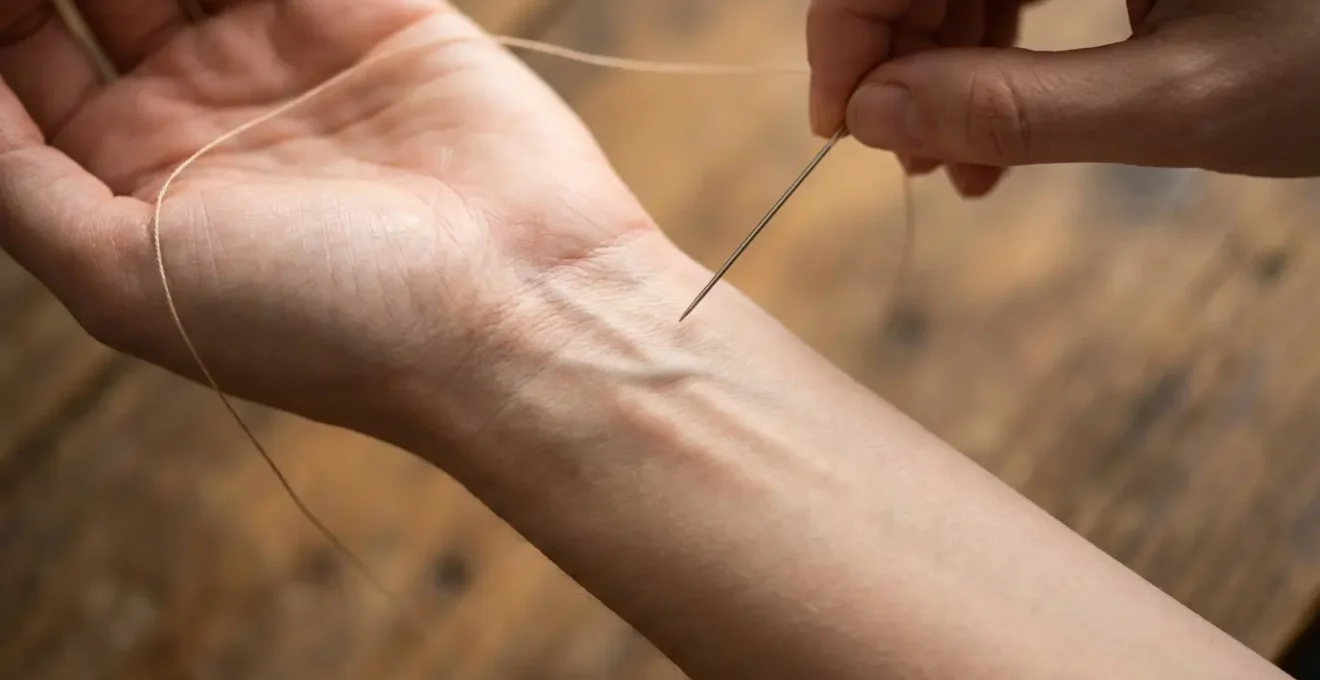
If the movement is weak or unclear, try lifting the thread slightly. Sometimes a small change in height can make the movement more distinct. It can also be helpful to have a partner or friend observe the movement, as they can provide a more objective viewpoint. This simple method connects you directly to the subtle energies at play.
Remember, the goal isn’t to force an answer but to create a quiet space for your intuitive senses to come forward through the simple swing of a needle.
Reading the Wrist or the Belly: Which is More Accurate?
Once you’re comfortable with the idea of dowsing, a common question arises: where should you hold the pendulum? The two most popular methods are dowsing over the pregnant belly and dowsing over the wrist. Neither is definitively “better,” as they operate on slightly different energetic principles. The best method for you depends on your personal connection to the practice and the stage of the pregnancy.
Reading over the belly is the most direct approach. By holding the pendulum about an inch above the pregnant belly, you are attempting to connect directly with the baby’s own developing energy field. This method is often preferred later in the pregnancy, typically after 12 weeks, when the baby’s energy is considered stronger and more distinct from the mother’s. Reading over the wrist, however, accesses the mother’s systemic energy. The theory here is that the mother’s entire body, including her circulatory and nervous systems, holds the intuitive knowledge or energetic imprint of the child she is carrying. It’s an indirect but powerful method that can be used at any point in the pregnancy.
| Method | Best Timing | Key Advantages | Traditional Interpretation |
|---|---|---|---|
| Wrist Method | Any trimester | Accesses mother’s intuitive knowing through her own energy system. | Works through mother’s systemic energy; less direct but taps into deep intuition. |
| Belly Method | After 12 weeks | Hover pendulum an inch over pregnant belly for a direct connection to the baby’s energy field. | Back-and-forth swing indicates boy, circular motion indicates girl. |
Variations in practice are common and reflect a rich history of folk tradition. For example, some rituals involve threading a wedding ring onto a chain, bobbing it on either side of the wrist a set number of times, and then holding it over the palm or wrist to see the swing. The key is to find the method that feels most natural and resonant for you. Trust your instincts on which point of contact provides the clearest response.
Ultimately, both methods are simply different doorways to the same intuitive information. Experiment with both to see which one yields a more confident and consistent movement.
The Mistake of Letting Your Desire Influence the Swing
This is the most critical lesson in all of dowsing: the pendulum does not have a mind of its own. It is a finely tuned amplifier of your own subtle, unconscious muscle movements. This phenomenon is known as the ideomotor response. Your thoughts, expectations, and especially your desires, create tiny, involuntary movements in your hand and arm that cause the pendulum to swing in the direction you are subconsciously anticipating. This is not a failure; it is the very mechanism through which dowsing works.
The greatest challenge, therefore, is not in reading the swing, but in silencing your conscious mind and desires so that a deeper, more neutral intuition can come through. If you desperately want a girl, your subconscious mind knows this, and you will almost certainly produce a circular swing. This is not a prediction; it is a reflection of your own hope. True dowsing requires achieving a state of energetic neutrality. As research on ideomotor movements reveals that the effect is produced most clearly when conscious intention is turned off, the dowser’s job is to step aside mentally.
Achieving this state of neutrality is a skill that can be learned. It involves acknowledging your desires and then consciously setting them aside. People with an external locus of control—those who are more comfortable letting things happen without feeling the need to be in charge—often have an easier time with this.
Your Action Plan: The Neutrality Protocol to Avoid Bias
- Acknowledge Preference: Before you begin, state any preference you have out loud. For example, “I would love to have a girl, and I am now releasing that desire for the purpose of this reading.” This helps detach you from the outcome.
- Use Grounding Techniques: Take a few deep breaths before you start. Feel your feet on the floor. The goal is to be present in your body, not lost in your thoughts about the future.
- Embrace the External: Remind yourself that you are an observer, not a director. People who feel less conscious control often allow for a better ideomotor response because they are not trying to “make” it happen.
- Trust the Unconscious: Remember that these movements occur without your perceived conscious control. Your role is simply to hold the pendulum steady and allow the response from your unconscious or intuitive self to emerge.
- Release Attachment: Once the reading is complete, thank your intuitive self for the information and release any attachment to it. Treat it as a piece of intuitive data, not an unchangeable fact.
By mastering your inner state, you transform the pendulum from a mirror of your hopes into a potential window to your intuition.
When in the Pregnancy is the Energy Strong Enough to Read?
One of the most practical questions expectant parents ask is, “How soon can we try this?” The answer differs significantly between modern medical science and ancient dowsing tradition. From a medical standpoint, a baby’s gender is typically determined with high accuracy via an anatomy scan ultrasound, which usually takes place between 18 and 22 weeks of pregnancy. This is when the physical structures are developed enough to be clearly visible.
From an energetic or intuitive perspective, however, the rules are different. Dowsing traditions have existed for as long as humans have been having children, and these practices are not bound by the timeline of physical development. The belief is that the energetic blueprint or signature of the child exists from the moment of conception. Therefore, many dowsers believe that the gender can be predicted at any stage of the pregnancy—and some traditions even practice it before conception to ask about the energy of a future child.

The “strength” of the energy is less about the fetus’s physical size and more about the dowser’s ability to tune in. For some, the energy may feel clearer or more distinct as the pregnancy progresses, especially when dowsing directly over the belly. For others using the wrist method, the information is considered to be present in the mother’s system immediately. There is no “wrong” time to try. The best time is simply when you feel calm, centered, and genuinely open to the experience, free from the pressure of getting a “correct” answer.
Instead of asking if the energy is strong enough, it’s often more helpful to ask if your own intuitive channel is quiet and clear enough to listen.
How to Program Your Pendulum for “Yes”, “No”, and “Maybe”?
While gender prediction often relies on the traditional circular/linear swings, a more versatile dowsing practice involves programming your pendulum for “Yes,” “No,” and “Maybe” responses. This technique establishes a clear and consistent communication system between you and your subconscious. It’s like creating a personal language. This is essential for asking more direct questions and verifying your findings. It’s a foundational skill for any serious dowser.
Programming is an intentional process of establishing a “verbal contract” with your subconscious. You are not asking a spirit or an outside force; you are asking your own inner intelligence to agree on a set of signals. The movements are still generated by the ideomotor response, but now they are tied to specific, agreed-upon meanings. In fact, some research has shown that in certain contexts, people can answer questions more accurately with these subtle muscle movements than with conscious guessing.
Follow these steps to program your pendulum:
- Hold the Pendulum: Hold your pendulum steady and quiet your mind.
- Establish “Yes”: Say aloud or in your mind, “Please show me my ‘Yes’ response.” Be patient and observe the movement. It might be a forward-and-back swing, a side-to-side swing, or a clockwise circle. Whatever it is, this is now your “Yes.”
- Establish “No”: Once the pendulum is still again, say, “Please show me my ‘No’ response.” It will almost always be a different, distinct movement from your “Yes.”
- Establish “Maybe”: You can also program a response for “Maybe,” “I don’t know,” or “Question is unclear.” This is often a wavering or erratic movement.
- Test and Verify: Test the calibration by asking simple questions with known answers. “Is my name [Your Name]?” should yield a “Yes.” “Is my name Bob?” should yield a “No.” Do this until the responses are consistent and reliable.
Once programmed, you can ask direct questions like, “Is the dominant energy of the baby female?” and see if the response matches the circular/linear swing you observed earlier. This provides a powerful method of cross-verification.
Gut Instinct or Trauma Response: How to Tell the Difference?
As you delve into intuitive practices like dowsing, you are essentially learning to listen to the subtle signals of your own body and mind. However, not every strong feeling is pure intuition. It’s crucial to learn to distinguish between a calm, clear “gut instinct” and a reactive, fear-based “trauma response” or simple anxiety. Your hopes, fears, and past experiences can all create powerful energetic noise that can easily be mistaken for an intuitive hit.
Psychological factors play a significant role. For instance, a study found that individuals with high “transliminality”—a personality trait related to sensitivity to subtle psychological phenomena—performed better with pendulums. Your mindset, such as whether you have an internal or external locus of control, also affects your ability to allow the ideomotor response to function without interference. Anxiety often creates a looping, repetitive thought pattern, while true intuition tends to arrive once, with a sense of clarity and peace, even if the information is unexpected. As scientific tests demonstrate, honest and intelligent people can unconsciously engage in muscular activity consistent with their expectations or anxieties.
So how do you tell them apart? Here are some ways to differentiate the signals:
- Check Physical Sensations: True intuition often feels calm, expansive, and centered in your gut or heart. Anxiety typically feels constricting, frantic, and is often felt in the chest and throat.
- Notice the Tone: Intuition is neutral and informational. An anxiety-based response is often loud, demanding, and emotionally charged with “what ifs.”
- Look for Repetition: Anxiety and desire tend to loop, asking the same question over and over, hoping for a different answer. Intuition delivers its message and then falls silent.
- Use Your Pendulum for Verification: Once you are in a neutral state, you can ask your programmed pendulum directly: “Is this feeling I’m having pure intuition?” or “Is this feeling based in fear/desire?”
Learning this distinction is not just key to dowsing; it’s a valuable skill for navigating life with greater wisdom and self-awareness.
Key takeaways
- The pendulum’s swing is an ideomotor response, amplifying your subconscious knowledge, not a message from an external force.
- Your personal desire for a boy or girl is the biggest source of interference; achieving energetic neutrality is the most critical skill.
- Programming a clear “Yes/No” system with your pendulum allows for more direct questioning and verification of results.
Dowsing Pendulum 101: How to Get Reliable Yes/No Answers?
We’ve explored the theories, methods, and psychological nuances of pendulum dowsing. Now, let’s synthesize it all into a clear, reliable process. Getting consistent answers is not about luck; it’s about discipline, preparation, and respect for the practice. It’s important to hold this practice with a balanced perspective. While traditionally practiced for centuries, dowsing is formally considered a pseudoscience, and its results can often be explained by unconscious psychological phenomena like the ideomotor effect.
Embracing this, we can use the pendulum as a tool to consciously tap into that unconscious knowledge. A reliable dowsing session is built on a foundation of best practices. First, choose a pendulum that feels right to you. While crystal pendulums are popular, a simple wood pendulum can be beneficial as it’s considered neutral to ambient energy. The material, however, is less important than your connection to the tool.

Before each session, you must clear your pendulum of any residual energy. This can be done by smudging it with sage, leaving it in moonlight overnight, or simply tapping it on a piece of wood to physically discharge any static energy. This ensures you are starting with a clean slate. Finally, the way you phrase your questions is paramount. Avoid ambiguous or future-based questions. Instead of “Will I have a boy?” ask a present-tense, energy-based question like, “Is the dominant energy present that of a male?” This keeps the focus on what your intuition can perceive *now*.
By consistently applying these principles—clearing your tool, neutralizing your mind, and phrasing your questions precisely—you create the optimal conditions for your intuition to speak clearly. This is the path from random swinging to reliable answers.