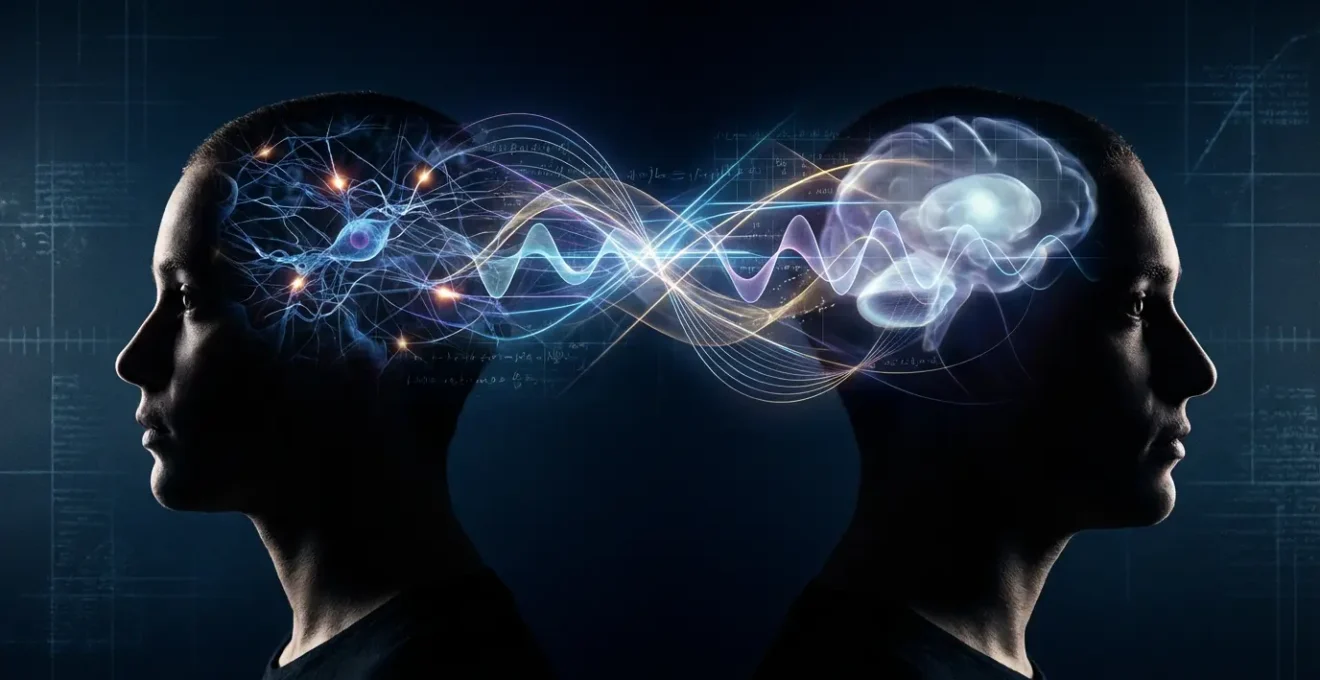
Contrary to popular belief, parapsychology is not about proving magic, but about methodically detecting small, statistically significant signals of consciousness.
- Research shows a measurable ‘experimenter effect,’ where a skeptic’s presence can actively suppress psi phenomena in lab settings.
- Modern studies have moved beyond simple card tests to sophisticated protocols like the Ganzfeld experiment to isolate genuine psi from sensory leakage and bias.
Recommendation: Approach the topic not with blind faith or rigid dismissal, but with an understanding of the scientific methodology used to separate the signal from the noise.
The field of parapsychology often evokes images of spoon-bending, séances, and crystal balls, leading to its frequent dismissal from the halls of serious science. For the rational mind, the discourse is typically a binary choice: either embrace anecdotal tales as proof or reject the entire domain as pseudoscience. This debate, however, largely misses the point of modern parapsychological research. The central task for today’s researchers is not to “prove” psychic abilities in a theatrical sense, but to apply rigorous scientific methods to investigate anomalous phenomena of consciousness, often referred to as psi.
The core challenge lies in detecting a very faint signal amidst a sea of statistical noise. Mainstream science often struggles with concepts that challenge a purely materialistic worldview, such as consciousness acting at a distance. Yet, for over a century, a dedicated branch of inquiry has been developing protocols to study these phenomena under controlled laboratory conditions. Instead of getting caught in the belief-versus-skepticism deadlock, a more productive approach is to examine the methodology itself. The real question is not “Is it magic?” but “Can it be measured?”
This article provides a scientific framework for understanding psi phenomena. We will move beyond the debate to explore the evidence, the research protocols, and the subtle factors that influence outcomes in parapsychology labs. We will examine why a skeptic’s disbelief may be more than just an opinion, how researchers distinguish a genuine psychic hit from a coincidence, and what the data says about the nature of consciousness itself. By focusing on the scientific process, we can begin to appreciate the complex and fascinating inquiry into the bridge between mind and matter.
To navigate this complex topic, this article is structured to build from foundational concepts to practical applications and theoretical implications. The following sections will guide you through the evidence-based landscape of modern parapsychology.
Summary: A Scientific Inquiry into Parapsychology and Psi Phenomena
- Why Skepticism Can Actually Block Psychic Phenomena in Labs?
- How to Conduct a Zener Card Test for ESP Accuracy?
- Telekinesis or Psychokinesis: Is There a Difference?
- The Error of Interpreting Every Coincidence as Psi
- How to Lower Brain Waves to Increase Psi Success Rates?
- Why Minds Can Connect Instantly Across Distances?
- Anxiety or Psychic Hit: Which Voice Is Warning You?
- Exploring Unseen Paranormal Phenomena: A Beginner’s Guide
Why Skepticism Can Actually Block Psychic Phenomena in Labs?
A persistent finding in parapsychology, and one of the most challenging for conventional science, is the “experimenter effect.” This isn’t merely about experimenter bias in recording data; it suggests that the consciousness, beliefs, and expectations of the observer can actively influence the outcome of an experiment. The most well-documented example of this is the sheep-goat effect. In this context, “sheep” are participants who believe in the possibility of psi, while “goats” are those who are skeptical or disbelieve. Across decades of research, a consistent pattern has emerged.
Studies consistently show a significant variance in performance, where believers score, on average, 30% higher in psi tasks than skeptics. Goats not only fail to score above chance but sometimes score statistically *below* chance, a phenomenon known as psi-missing. This suggests their disbelief isn’t a neutral stance but an active influence that appears to inhibit the phenomenon. From a scientific perspective, this is both a methodological nightmare and a fascinating piece of data. It implies that a perfectly designed experiment could fail simply due to the psychological state of the people in the room.
The theoretical explanation often points to parallels in quantum physics, specifically the observer effect, where the act of measuring a quantum system fundamentally changes its state. In this model, consciousness is not a passive bystander but an integral part of reality. A skeptical mind, focused on the impossibility of an event, may “collapse the waveform” of possibilities into a null result, while an open, expectant mind allows for a different outcome.
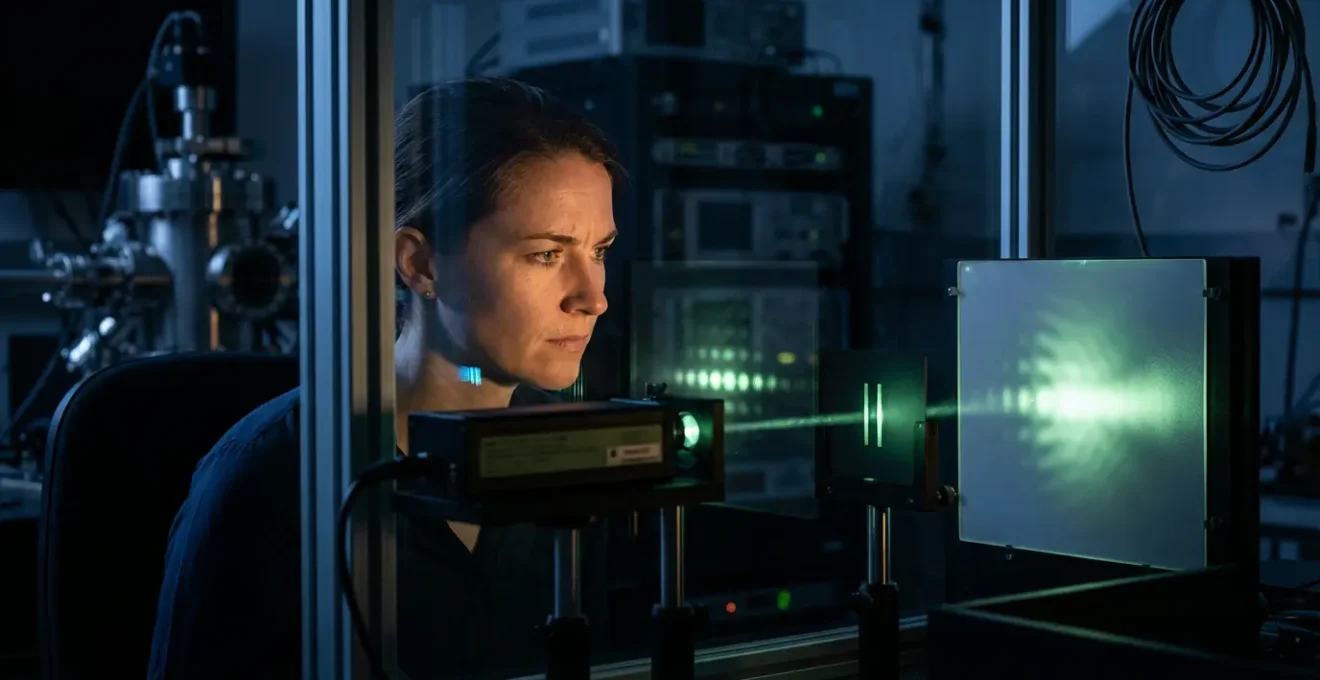
As this visualization suggests, the observer is not separate from the experiment. This principle forces parapsychology to account for variables that most other sciences can ignore. It means that replicating an experiment requires not just replicating the physical setup, but also the psychological and intentional states of the participants and researchers, a profoundly difficult task. Thus, skepticism in a lab may not just be a philosophical position but a measurable, active force that can block the very phenomena being studied.
How to Conduct a Zener Card Test for ESP Accuracy?
The Zener card test is the most iconic symbol of early ESP research. Developed by psychologist Karl Zener in the 1930s for experiments with J.B. Rhine at Duke University, the deck consists of 25 cards bearing five simple symbols: a circle, a cross, wavy lines, a square, and a star. The procedure appears straightforward: one person (the “sender”) looks at a card, and another (the “receiver”), who cannot see the card, attempts to identify the symbol. With five options, pure chance would predict a success rate of 20%, or 5 correct guesses out of 25. Scores consistently and statistically above this baseline would suggest the presence of ESP.
A basic, informal Zener test can be conducted as follows:
- Preparation: Use a standard 25-card Zener deck. The sender and receiver should be in a quiet space, free from distractions. They should not be able to see or hear each other providing cues.
- Shuffling: The sender shuffles the deck thoroughly to ensure randomization.
- The Trial Run: For each of the 25 cards, the sender concentrates on the symbol and the receiver states their impression. The sender records both the target symbol and the receiver’s guess without giving any feedback until the entire deck is finished.
- Scoring: Count the number of “hits.” A score of 5 is average. A score of 10 or more is statistically significant and warrants further testing.
However, it is crucial for any rationalist to understand that modern parapsychology has largely moved beyond this simple “forced-choice” paradigm. The method is highly susceptible to sensory leakage (unintentional cues) and experimenter bias. The simplicity that made it famous is also its scientific weakness.
Case Study: Evolution from Zener Cards to Modern ESP Testing Methods
Researchers at the Institute of Noetic Sciences (IONS) and other leading institutions have advanced far beyond Zener cards. Due to the limitations of forced-choice tests, they developed more sophisticated “free-response” protocols. The most prominent is the Ganzfeld experiment. In a Ganzfeld session, the receiver is placed in a state of mild sensory deprivation (e.g., with white noise playing through headphones and halved ping-pong balls over their eyes) to reduce external “noise” and amplify the internal “signal” of psi. Meanwhile, a sender in another room concentrates on a randomly selected video clip or image. The receiver describes their impressions, which are recorded. Afterward, the receiver is shown four options (the target and three decoys) and must choose which one best matches their impressions. This method provides richer, more detailed data and has stronger controls against bias and sensory cues, making it a cornerstone of modern ESP research.
Telekinesis or Psychokinesis: Is There a Difference?
The terms “telekinesis” and “psychokinesis” are often used interchangeably in popular culture to describe the ability to move objects with the mind. However, within the scientific framework of parapsychology, there is a crucial distinction. “Telekinesis” typically refers to macro-PK: large-scale, observable effects like bending spoons, levitating tables, or influencing dice rolls. These events are dramatic but are notoriously difficult to reproduce under controlled laboratory conditions and are often associated with anecdotal evidence or accusations of fraud.
In contrast, “psychokinesis” (PK) is the broader and more scientifically accepted term. It primarily encompasses micro-PK, which is the study of statistically measurable influences of consciousness on random physical systems. Rather than trying to bend a spoon, a micro-PK experiment might test whether a person’s intention can influence the output of a Random Number Generator (RNG), a device designed to produce a perfectly unpredictable sequence of 0s and 1s. The effect is not visible to the naked eye; it is a tiny but persistent deviation from the 50/50 probability expected by chance, detectable only after thousands or millions of trials.
This focus on statistical measurement over visible spectacle is fundamental to the scientific approach. As pioneering researcher Robert Jahn stated:
Psychokinesis is the broader scientific term that primarily focuses on micro-PK — statistically measurable influence on random systems.
– Robert Jahn, Princeton Engineering Anomalies Research
The most famous research in this area came from the Princeton Engineering Anomalies Research (PEAR) laboratory. Over nearly three decades, the PEAR lab documented over 1 million trials where human operators attempted to influence various random systems. Their cumulative data showed small but highly statistically significant deviations in the direction of the operator’s intention. While controversial, this body of work represents a cornerstone of evidence for micro-PK, shifting the conversation from the spectacle of telekinesis to the subtle, measurable reality of psychokinesis.
The Error of Interpreting Every Coincidence as Psi
One of the greatest challenges for both the public and researchers in parapsychology is distinguishing a genuine psi event from a mere coincidence or the product of confirmation bias. The human brain is a pattern-seeking machine. We are wired to find meaning and connection in events, which can lead us to assign significance to random occurrences—thinking of a friend just before they call, for example. While compelling, such events are often statistically probable. Millions of people think about millions of other people every day; some of those thoughts will inevitably precede a phone call by chance.
This is the “noise” in the signal-to-noise problem. The “signal” of a true psi event is often weak, and the “noise” of chance, subconscious sensory cues, and cognitive biases is overwhelmingly loud. A scientifically rigorous approach to psi requires systematically filtering out this noise. A single, dramatic anecdote is not data. Data comes from repeated, controlled experiments where chance can be calculated and ruled out as an explanation. Without this rigor, we fall into the trap of apophenia—the tendency to perceive meaningful connections between unrelated things.
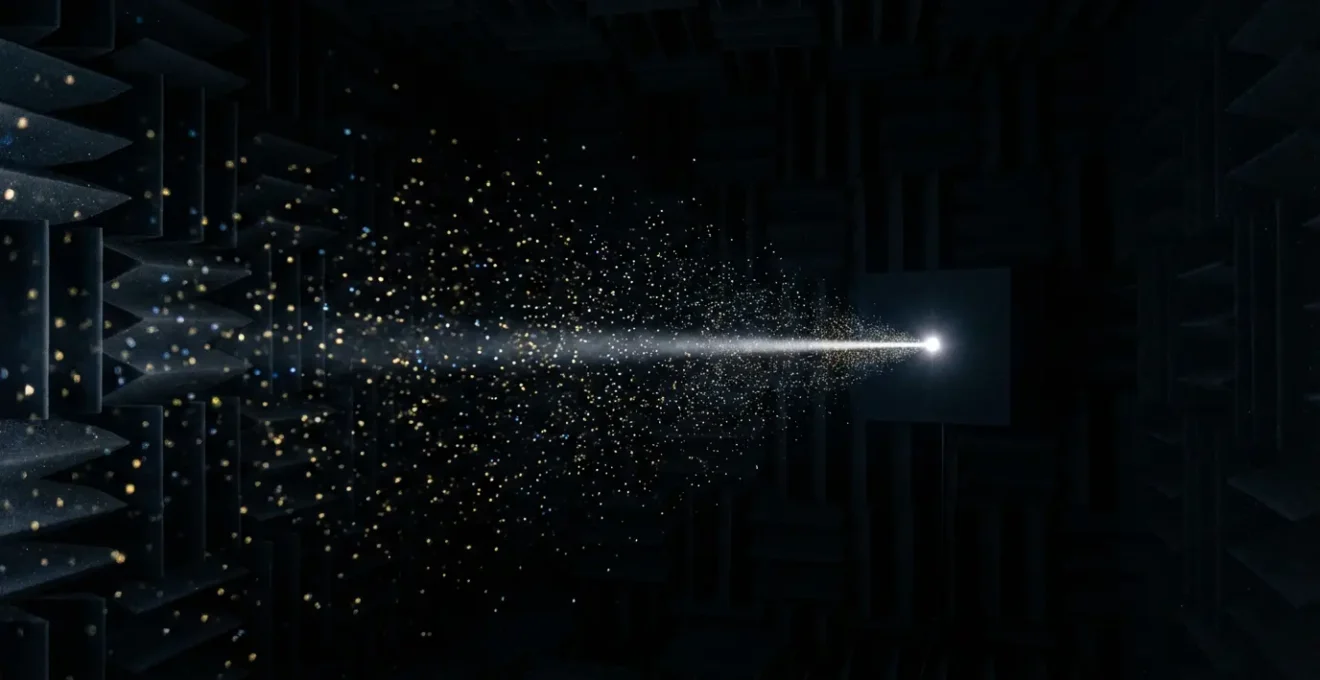
The image above visualizes this core challenge: isolating a tiny, coherent signal from a vast field of random noise. Before attributing an experience to psi, it’s essential to apply a critical filter. Researchers use complex protocols to do this, but individuals can use a simple diagnostic checklist to evaluate their own experiences more objectively.
Action Plan: Psi or Coincidence Diagnostic Checklist
- Was the event highly specific and unpredictable? (e.g., “I had a feeling a blue car would crash” vs. “I had a dream of my cousin Sarah getting a specific job offer she hadn’t even applied for.”)
- Can it be explained by subconscious sensory input? (e.g., Did you overhear a conversation or see a news report that planted the idea in your mind?)
- What was the emotional charge? (Psi hits are often described as neutral and calm, whereas anxiety produces racing, fear-based thoughts.)
- Did you document it *before* confirmation? (Writing down a premonition before the event occurs is crucial to avoid memory distortion and confirmation bias.)
- What is the statistical probability of chance occurrence? (How likely is it that this event would have happened anyway?)
How to Lower Brain Waves to Increase Psi Success Rates?
If psi phenomena are a real, albeit weak, signal, a key question for researchers is how to amplify that signal. Decades of research have pointed to a strong correlation between psi performance and the subject’s state of consciousness. Specifically, high levels of psi success are not typically found in our normal, busy, analytical state of mind (Beta brain waves, 13-30 Hz). Instead, the data suggests that “psi-conducive states” are associated with slower, more meditative brainwave frequencies.
Neuroscience research consistently demonstrates that brainwave frequencies in the Alpha (8-12 Hz) and Theta (4-8 Hz) ranges are most correlated with high psi hit rates. The Alpha state is associated with calm, relaxed awareness—the state you might be in during light meditation or right before falling asleep. The Theta state is even deeper, linked to deep meditation, REM sleep, and profound creativity. The hypothesis is that these slower brainwave states reduce the “noise” of the conscious, analytical mind, allowing the “signal” of subtle psi information to be perceived more clearly. In essence, to hear the whisper of intuition, you first have to quiet the shouting of the ego.
As such, a significant part of applied parapsychology involves training individuals to voluntarily enter these states. Fortunately, these techniques are not esoteric; they are well-established methods for relaxation and consciousness alteration that can be practiced by anyone. Several evidence-based techniques have proven effective in helping individuals achieve these psi-conducive states:
- Transcendental Meditation: Numerous studies show that practicing for 20 minutes twice daily can significantly increase Alpha and Theta wave production and quiet the prefrontal cortex, which is associated with analytical thought.
- Binaural Beats: Listening to specific audio frequencies, such as binaural beats at 7.83 Hz (the Schumann resonance), for 30 minutes can entrain the brain to the desired Theta frequency.
- Ganzfeld Sensory Deprivation: While a lab protocol, a simplified version can be done at home with halved ping-pong balls over the eyes and a source of red light and white noise to reduce external sensory input.
- Progressive Muscle Relaxation: Systematically tensing and relaxing muscle groups throughout the body is a powerful technique to release physical tension, which is often a barrier to achieving deeper mental states.
Why Minds Can Connect Instantly Across Distances?
The concept of telepathy, or direct mind-to-mind communication, is one of the most fascinating and challenging aspects of parapsychology. From a classical physics perspective, it seems impossible. There is no known energy or signal that travels from one brain to another that could carry such complex information without degrading over distance. Yet, anecdotal and experimental evidence for it persists. The scientific explanation for this phenomenon requires moving beyond classical physics and into the counterintuitive world of quantum mechanics, specifically through the concept of non-local consciousness.
The leading hypothesis is that consciousness, like quantum particles, may not be strictly “local”—that is, confined to a specific point in space (the brain). Instead, it may have non-local properties. This idea is inspired by quantum entanglement, a confirmed physical phenomenon where two particles can be linked in such a way that measuring the state of one instantly influences the state of the other, regardless of the distance separating them. Albert Einstein famously called this “spooky action at a distance.”
Leading parapsychology researcher Dean Radin has long proposed that consciousness may operate on similar principles:
Quantum entanglement demonstrates that particles can be instantaneously correlated regardless of distance – consciousness might operate on similar non-local principles.
– Dean Radin, Entangled Minds: Extrasensory Experiences in a Quantum Reality
If minds are non-locally interconnected, distance becomes irrelevant. This would explain not only telepathy but also other phenomena like remote viewing. Research in this area seeks to find evidence of these non-local correlations in human physiology.
Case Study: Twin Telepathy Research at the University of Virginia
The Division of Perceptual Studies at the University of Virginia has conducted compelling research exploring these connections. In controlled studies, they have documented cases of identical twins separated by significant distances showing simultaneous physiological responses. For instance, when one twin is subjected to a mild, unexpected stimulus (like a flash of light or a sound), the other twin, isolated in a separate, shielded room, sometimes exhibits a corresponding spike in nervous system activity on a polygraph at the exact same moment. Researchers use rigorous protocols to rule out chance, shared environmental factors, and other conventional explanations, suggesting a form of non-local communication that defies classical models but aligns with quantum-inspired theories of consciousness.
Anxiety or Psychic Hit: Which Voice Is Warning You?
A common and often distressing experience is a sudden feeling of dread or a “warning voice” in your head. The critical question for a rational mind is: is this a valuable intuitive or psychic insight, or is it simply a manifestation of anxiety? Mistaking one for the other can have significant consequences. Acting on anxiety as if it were a premonition can lead to poor decisions, while dismissing a genuine intuitive hit as “just anxiety” could mean ignoring important information. Fortunately, researchers and experienced intuitives have identified qualitative differences between the two experiences. Learning to spot these differences is a crucial skill in emotional and psychological self-awareness.
Anxiety is typically ego-driven. It stems from past traumas, future fears, and repetitive thought loops. It is emotionally “loud,” often accompanied by a racing heart, shallow breathing, and a feeling of panic. An intuitive or psychic hit, by contrast, is often described as emotionally “quiet” or neutral. It arrives suddenly, as a single, clear impression, without the repetitive chatter of worry. It feels impersonal, like a piece of data being delivered, rather than a product of your own fears. The physical sensation is also different—often described as a calm “gut feeling” or a sense of deep “knowing” rather than the jittery agitation of anxiety.

This table breaks down the key characteristics to help distinguish between a spiraling anxious thought and a potentially legitimate intuitive insight. By paying close attention to these qualities, one can learn to better parse their internal signals.
The following table provides a comparative analysis to help differentiate these internal signals, as explored in discussions on the nature of psi and consciousness.
| Characteristic | Anxiety Response | Intuitive Hit |
|---|---|---|
| Emotional Charge | High, fear-based | Neutral, calm knowing |
| Pattern | Repetitive, looping thoughts | Single, clear impression |
| Origin | Ego-driven, past experiences | Impersonal, sudden arrival |
| Specificity | Vague, worst-case scenarios | Specific, actionable information |
| Physical Sensation | Racing heart, shallow breathing | Gut feeling, somatic marker |
Key Takeaways
- Parapsychological research is not a quest for magic, but a methodical search for small, statistically significant psi signals buried in statistical noise.
- The observer is part of the experiment; a person’s belief or skepticism (the “sheep-goat effect”) is a measurable variable that can actively influence outcomes.
- Distinguishing a genuine psi event from coincidence or anxiety requires critical analysis of its specificity, emotional quality, and statistical probability.
Exploring Unseen Paranormal Phenomena: A Beginner’s Guide
Embarking on an exploration of unseen phenomena requires a shift in perspective—away from the search for absolute proof and toward an appreciation for evidence-based inquiry. As we have seen, the scientific study of parapsychology is not about blind belief but about methodological rigor. It is defined by its continuous effort to improve the signal-to-noise ratio, to control for variables like experimenter belief, and to develop protocols that can withstand skeptical scrutiny. The journey begins with understanding the foundational categories of psi.
For a newcomer, the landscape can seem confusing, but it is generally organized into a few key areas of research. These phenomena are not treated as supernatural events, but as potential, if poorly understood, human faculties. Meta-analyses of presentiment experiments demonstrate odds of 125,000 to 1 against chance, providing a statistical foundation for taking these inquiries seriously. The following table, based on decades of research discussed in institutions like the University of Virginia’s Division of Perceptual Studies, offers a structured overview for the beginner.
| Phenomenon | Proposed Mechanism | Landmark Study | Skeptical Rebuttal |
|---|---|---|---|
| Telepathy | Quantum Entanglement | Ganzfeld Experiments | Sensory Leakage |
| Remote Viewing | Non-local Consciousness | SRI/Stargate Project | Information Bias |
| Precognition | Retrocausation | Presentiment Studies | Statistical Artifacts |
| Psychokinesis | Observer Effect | PEAR Lab (Princeton) | Publication Bias |
Understanding this framework is the first step. It allows one to move past sensationalism and engage with the real questions, challenges, and data that define the field. The path forward is one of critical thinking, open-mindedness, and a deep appreciation for the profound mysteries of consciousness that science is only just beginning to map.
To continue your exploration, the next logical step is to engage directly with the primary research and literature. Approach the subject not as a believer or a debunker, but as a scientific investigator, weighing the evidence for yourself and appreciating the complexity of the questions being asked.