The key to fast, specific Lenormand answers isn’t learning more spreads; it’s mastering the grammatical system that makes the cards talk.
- Unlike Tarot’s psychological archetypes, Lenormand uses a concrete vocabulary of nouns, verbs, and adjectives to build factual predictive sentences.
- Reading cards in isolation is the biggest mistake. The meaning emerges from their combination and order, creating a precise narrative.
Recommendation: Stop treating Lenormand like Tarot. Focus on combining cards into simple sentences to unlock its power for direct, event-focused predictions.
You pull a few cards, hoping for a clear answer about your job, a relationship, or your finances. Instead, you’re left with vague feelings and abstract advice. If you’re coming from Tarot, you might be tempted to interpret each card’s “energy” or what it “means to you.” This is the fastest way to get frustrated with Lenormand. The desire for predictive cartomancy that deals with daily life—real events, not just psychological states—is what draws many to this compact 36-card deck.
The common approach is to learn dozens of different spreads, but this misses the point. The power of Lenormand isn’t in the layout; it’s in its language. While other systems like Oracle cards offer spiritual guidance, and Tarot explores deep psychological ‘why’s, Lenormand is built for the ‘what,’ ‘who,’ ‘when,’ and ‘where.’ It operates like a brutally honest friend who tells you what’s going to happen, not just how you should feel about it.
But what if this brutal honesty wasn’t a flaw, but its greatest feature? The secret to unlocking fast, specific answers lies not in memorizing spreads, but in understanding Lenormand’s predictive syntax. This guide will deconstruct the grammatical system behind the cards, showing you how to move beyond isolated meanings and start building the clear, factual predictions you seek. We will explore how to make sense of its directness, use its most powerful techniques, and apply its logic to get the answers you need.
This article provides a structured path to mastering Lenormand’s unique predictive power. Each section builds upon the last, moving from core principles to practical application for clear, actionable insights.
Summary: How to Get Specific Answers with Lenormand Spreads
- Why Lenormand is Brutally Honest Compared to Tarot?
- How to Read the Grand Tableau for a Yearly Overview?
- Lenormand or Oracle Cards: Which is Better for Daily Events?
- The Error of Reading Lenormand Cards in Isolation
- How to Combine Nouns and Adjectives for Precise Meanings?
- Why Love Oracles Offer More Detail Than General Tarot?
- Direct Confrontation or Silent Observation: Which Reveals More?
- How the Cupid Oracle Predicts Your Romantic Future Accurately?
Why Lenormand is Brutally Honest Compared to Tarot?
The fundamental difference between Lenormand and Tarot is one of purpose. Tarot is a psychological tool; it delves into the ‘why’ and ‘how’ of your inner world using rich, archetypal imagery. Lenormand is a practical, event-focused system. It is not concerned with your spiritual growth or subconscious patterns; it is designed to tell you what is happening, or what will happen, in the material world. This is why its messages feel “brutally honest”—they are stripped of emotional padding and deliver factual statements.
While a Tarot card like The Tower signifies a dramatic, life-altering upheaval on a deep level, the Lenormand equivalent might be Scythe + Tower, meaning a “sudden end at an institution” like being fired. The focus is on the event itself. This directness is a feature, not a bug. Professional readers note that when used correctly, a Lenormand combination can deliver a clear prediction with stunning accuracy. It’s a system built on a concrete vocabulary, where cards represent tangible things: the Rider is news, the Letter is a document, the House is your home.
This directness requires a different mindset. Instead of asking “What do I need to learn from this situation?”, a better Lenormand question is “What is the primary obstacle to my promotion?”. This shift from introspective to investigative is the first step in harnessing its predictive power. Handling its honesty means seeing its warnings as opportunities to change course, not as fixed, dreadful outcomes.
A Lenormand combination will throw out a clear prediction with STUNNING accuracy
– Nightingale Tarot, Professional psychic services comparison
To master this direct communication, you must embrace its nature. Treat the cards not as symbols to be meditated upon, but as words in a sentence waiting to be read. This is the core of Lenormand’s power.
How to Read the Grand Tableau for a Yearly Overview?
The Grand Tableau, a spread using all 36 cards, is often seen as the intimidating final boss of Lenormand. However, for a pragmatic reader seeking a yearly overview, it’s better viewed as a strategic dashboard for your life. Instead of trying to read every single card combination, the key is to focus on “hot spots” to identify key themes and potential challenges for the upcoming year without getting lost in the details.
This is done using the Houses system, where each of the 36 card positions corresponds to a life area (Position 1 is the House of the Rider for news, Position 25 is the House of the Ring for commitments, etc.). To get a quick overview, you simply identify which card has landed in a critical House. A challenging card in a key house acts as a red flag, pointing you directly to a life area that requires attention.
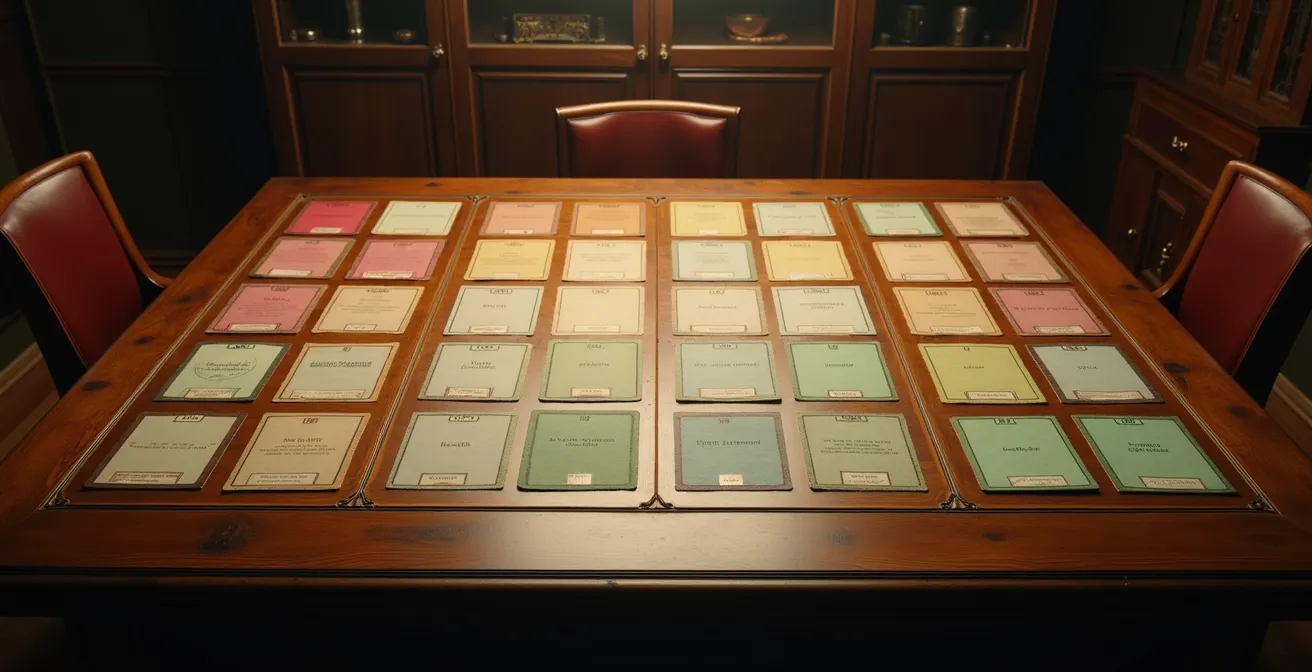
This method transforms the Grand Tableau from an overwhelming tapestry into a scannable diagnostic tool. You aren’t predicting every week of the year; you are identifying the major headlines. For example, finding the Fox card in the House of the Ring (House 25) is a clear warning about potential deception in contracts or commitments for the year. This gives you a specific, actionable area to monitor.
The table below, based on an analytical method for pinpointing key life areas, shows how to quickly identify these hot spots and what follow-up action to take. It demonstrates a practical approach where, as shown in a guide from Labyrinthos Academy, the Grand Tableau becomes a starting point for more focused investigation.
| House Position | Life Area | Red Flag Combinations | Quick Spread Follow-Up |
|---|---|---|---|
| House of Ring (25) | Commitments | Fox in this house = deception in contracts | 3-card: Fox + Ring + ? |
| House of Heart (24) | Love life | Scythe here = sudden ending | 5-card love check |
| House of Fish (34) | Finances | Mice here = losses | 3-card money flow |
| House of Tree (5) | Health | Coffin here = health crisis | 5-card health scan |
Lenormand or Oracle Cards: Which is Better for Daily Events?
For a daily draw, the choice between Lenormand and Oracle cards depends entirely on your goal. Are you seeking inspiration and emotional guidance, or do you need a concrete forecast of the day’s events? Oracle cards, with their thematic messages and evocative imagery, are excellent for setting a mood or providing a spiritual perspective. They answer the question, “What energy should I focus on today?” A card might say “Trust the Journey,” offering a gentle nudge.
Lenormand, by contrast, answers the question, “What is going to happen today?”. Its strength lies in creating a short, factual narrative. A simple three-card pull of Man + Ship + Letter doesn’t suggest a feeling; it predicts an event: “A man will travel for a document/communication.” This level of specificity is unparalleled for practical planning and logistical awareness. If you need to know if a package will arrive or if a meeting will be productive, Lenormand is the superior tool.
The time and effort required for interpretation also differ dramatically. An Oracle card often invites several minutes of contemplation and journaling. A three-card Lenormand spread can be read in under 30 seconds once you understand its grammatical structure. This makes it ideal for a quick, no-nonsense check-in before you start your day. It’s less about deep soul-searching and more about being practically prepared.
This comparative analysis, drawn from expert observations like those from Emily Rose Divination, highlights the distinct roles of each tool. One provides emotional support, the other a tactical advantage. For anyone focused on navigating daily events, Lenormand’s concrete storytelling is far more useful.
| Aspect | Lenormand | Oracle Cards | Best For |
|---|---|---|---|
| Answer Style | Concrete narrative (‘Man travels for work’) | Emotional nudge (‘Trust the journey’) | Lenormand: Planning Oracle: Inspiration |
| Specificity | Who, what, when, where details | Themes and feelings | Lenormand: Logistics Oracle: Mood setting |
| Time to interpret | 30 seconds for 3 cards | 5+ minutes contemplation | Lenormand: Quick check Oracle: Morning meditation |
| Problem-solving | Shows exact obstacles | Offers spiritual perspective | Lenormand: Practical fix Oracle: Emotional support |
The Error of Reading Lenormand Cards in Isolation
The single biggest mistake newcomers make with Lenormand is treating it like Tarot—reading each card individually. A Lenormand card has very little meaning on its own. The Rider is just “news,” the Sun is just “success.” The magic, and the precision, happens when they are combined. Lenormand is a language, and its cards are words. Reading them in isolation is like trying to understand a sentence by looking at each word separately without considering grammar or context.
The cards form a predictive sentence, creating an “invisible thread” of meaning between them. The order of these words is critical and completely changes the narrative. This concept, often called the “noun + modifier” technique, is the engine of Lenormand’s specificity. An analysis of card pairings provides a perfect example: Sun + Letter can be read as “successful communication” or “a message about success.” Here, Sun acts as an adjective describing the Letter. However, if you reverse the order to Letter + Sun, the meaning shifts to “a communication that leads to success.” The Letter becomes the cause, and Sun the effect. The nuance is entirely in the syntax.
This grammatical approach forces you to build a story. A positive card like the Sun isn’t a blanket guarantee of a good outcome. You must ask: what is it modifying? Sun + Coffin is “a successful ending,” which is very different from Coffin + Sun, “an ending that brings success.” Ignoring these connections and reading each card’s “vibe” individually will only lead to confusing, generic, and often incorrect interpretations. To get specific answers, you must think like a translator, not a mystic.
Your Action Plan: Troubleshooting Confusing Combinations
- Identify the ‘anchor noun’: Pinpoint the most concrete person, place, or thing in your spread (e.g., Man, House, Letter). This is your subject.
- Collect the modifiers: Treat all other cards as adjectives or verbs describing or acting upon that anchor noun.
- Trace the narrative flow: If Card 1 sets the scene (e.g., Crossroads), it creates an invisible thread that influences the outcome in Card 3.
- Check the context: Never read a positive card like Clover or Sun in isolation. Always check what it is modifying or what is modifying it.
- Reset to grammar: When stuck, return to the basic formula: Noun (Who/What) + Adjective/Verb (What’s happening) + Outcome.
How to Combine Nouns and Adjectives for Precise Meanings?
To move from vague impressions to sharp predictions, you must start thinking of the Lenormand deck as a pack of grammatical flashcards. Every card can function as a noun (a person, place, or thing), an adjective (a descriptor), or a verb (an action). Mastering this “Lenormand Grammar” is the key to constructing the clear, factual sentences you’re looking for.
The first step is to categorize the cards. Some cards are almost always the main subject of the reading. These are the “heavy nouns” like Man, Woman, House, or Tree. They anchor the reading. Other cards are “light nouns” like Letter, Book, or Key, representing objects or concepts that are part of the story but not the central character. Then you have action-oriented cards, or “verbs,” like the Rider (arrives), the Ship (travels), or the Scythe (cuts). Finally, many cards act as “adjectives,” adding color and detail. The Clover makes something lucky, the Clouds make it confusing, and the Sun makes it successful.
With this framework, a three-card spread becomes a simple sentence. Consider the combination: Woman + Clouds + Book. * Woman: Heavy Noun (Our subject). * Clouds: Adjective (Describes her state or the situation). * Book: Light Noun (The object of the sentence).
You can read this as: “The woman is confused about a secret” or “The woman is facing uncertainty regarding knowledge/education.” The grammar provides a structure that eliminates guesswork. The table below serves as a cheat sheet for understanding these grammatical roles, helping you to quickly deconstruct any spread into a coherent and precise message.
| Grammar Type | Cards | Function | Weight |
|---|---|---|---|
| Heavy Nouns | Man, Woman, House, Tree | Main subjects/anchors | Primary focus |
| Light Nouns | Letter, Book, Key | Objects/concepts | Secondary elements |
| Verbs | Rider (arrives), Ship (travels), Storks (changes) | Actions/movements | Dynamic elements |
| Adjectives | Clover (lucky), Sun (successful), Clouds (confused) | Descriptors/modifiers | Color the nouns |
| Conjunctions | Crossroads (or), Paths (and/but) | Connectors/choices | Link concepts |
Why Love Oracles Offer More Detail Than General Tarot?
When it comes to matters of the heart, querents crave specifics. This is where both specialized love oracles and the Lenormand system outshine general Tarot. The reason is simple: vocabulary. A standard Tarot deck operates with universal archetypes. The Lovers card, for instance, can signify a major choice, a value alignment, or a harmonious union. It’s a powerful but broad symbol that speaks to the ‘why’ of a connection.
Love oracles and Lenormand, however, use a hyper-focused vocabulary. A love oracle might have a card that literally says “Reconciliation” or “Trust Issues.” There is no ambiguity. It’s a direct diagnosis of a specific theme within the relationship. This gives it a level of detail on the emotional and thematic level that Tarot’s archetypes can’t match.
Lenormand achieves this same level of detail through its grammatical combinations. Instead of a single “Lovers” archetype, it provides the building blocks to describe a multitude of romantic scenarios. As noted in a comparison of divination systems, Lenormand is superior for future-focused questions because it excels at answering ‘what’ and ‘where’. For a love question, it doesn’t just show a connection; it describes its nature and trajectory. The combination of Heart + Ring + Letter is not a vague feeling of love; it is a “love commitment on paper,” or a marriage contract. Similarly, Heart + Scythe is a “breakup,” and Heart + Ship is a “long-distance romance.” By combining its simple, concrete symbols, Lenormand constructs a detailed, event-focused narrative about the relationship’s future that is far more specific than a single Tarot card.
Direct Confrontation or Silent Observation: Which Reveals More?
There are two primary ways to approach a Lenormand reading for quick answers: direct confrontation or silent observation. The best method depends on your mental state and what you truly need to know. Neither is inherently better, but choosing the right one is crucial for getting clarity instead of fueling anxiety.
Direct Confrontation is the most common method. You have a specific question (“Will I get the job?”), you pull 3-5 cards, and you read the direct answer. This method is best when you need to make an actionable decision and are in a relatively calm state of mind. The cards provide a clear ‘yes’, ‘no’, or ‘maybe, if…’ scenario that helps you plan your next steps. For example, getting Rider + Letter + Ring for the job question clearly indicates “news of a contract is coming.”
Silent Observation, on the other hand, involves pulling a few cards without a specific question in mind, simply to see the “energy of the day” or to reveal underlying patterns. This is a far better approach when you are feeling anxious, obsessive, or stuck. Asking the same question repeatedly (a common habit when anxious) in the Direct Confrontation method will only give you confusing and contradictory results, feeding the obsessive cycle. The Silent Observation method bypasses your conscious anxiety. It might reveal an obstacle you weren’t even aware of, like showing the Fox (deceit) card, suggesting you need to be wary of something entirely different than what you were obsessing over. This method is for self-discovery and pattern recognition.
Choosing your method is a form of self-awareness. If you are ready for a hard truth to make a decision, use direct confrontation. If you feel you are spinning your wheels, use silent observation to see what you are missing. A good practice is to alternate methods throughout the week to develop both your predictive and intuitive skills.
Your Action Plan: Choosing Your Reading Method Based on Mental State
- Use the Direct Confrontation Method when you need to make an actionable decision. Ask your specific question and draw 3-5 cards for a straightforward answer.
- Use the Silent Observation Method for self-discovery. Draw cards without a question to see the “energy of the day” and reveal unconscious patterns.
- Perform a Mental State Check. If you are feeling anxious about a specific topic, avoid the Direct Confrontation method as it can fuel obsessive questioning.
- If you feel stuck or blocked, use Silent Observation. It can reveal unconscious obstacles you weren’t consciously aware of.
- Alternate your practice weekly. Use Direct Confrontation on certain days and Silent Observation on others to build a balanced skill set.
Key takeaways
- Lenormand’s accuracy comes from its grammatical system, not mystical energy; it builds factual sentences.
- The biggest error is reading cards in isolation. Meaning comes from combinations and their specific order (noun + adjective).
- For daily predictions about events, Lenormand’s concrete narrative is more useful than the emotional guidance of Oracle cards or the broad archetypes of Tarot.
How the Cupid Oracle Predicts Your Romantic Future Accurately?
While a dedicated “Cupid Oracle” deck uses specific romantic vocabulary, you don’t need one to get startlingly accurate predictions about your love life. The Lenormand system, when its grammatical rules are applied, functions as the most precise Cupid Oracle available. Its power lies in its ability to describe concrete actions and outcomes rather than just abstract feelings.
When you ask a question like, “Is there a future with my new partner?”, a theme-based oracle might give you a card like “Building a Foundation.” This is encouraging but lacks detail. What does that *look* like? Lenormand provides the blueprint. A reading of Man + House + Anchor delivers a stunningly clear prediction: “The man is establishing permanent stability.” It shows a tangible action, not just a mood. This is the difference between a comforting thought and actionable intelligence.
To use Lenormand as your own Cupid Oracle, you can use a simple, targeted spread like the “Cupid’s Arrow.” This 3-card spread maps the trajectory of romantic energy with factual precision. It’s not about what you hope for, but what is actually unfolding.
Your Action Plan: The Cupid’s Arrow Lenormand Love Spread
- Card 1 – The Archer’s Intent: This card represents the energy you or the other person are bringing to the relationship right now.
- Card 2 – The Arrow’s Path: This reveals the journey, key events, or obstacles along the romantic path.
- Card 3 – The Target/Outcome: This shows where the romantic energy is headed and the likely result.
- Example Reading (Man + Ship + House): A man (Archer’s Intent) embarks on a journey (Arrow’s Path) toward building a home or commitment (Target).
- Timing Tip: The cards in the path can even provide timing clues. The Ship suggests a journey of 3-6 months, the Rider indicates news in days, and the Tree points to a long-term, slow-growing development over years.
By framing your love questions within this structured, event-focused system, you transform the Lenormand deck into a powerful tool for romantic prediction, getting the clarity and detail that other systems often lack.
Now that you understand the grammatical engine behind Lenormand, the next logical step is to apply it consistently. Start by practicing with simple three-card daily draws, focusing on forming a complete sentence with a clear subject, verb, and object.