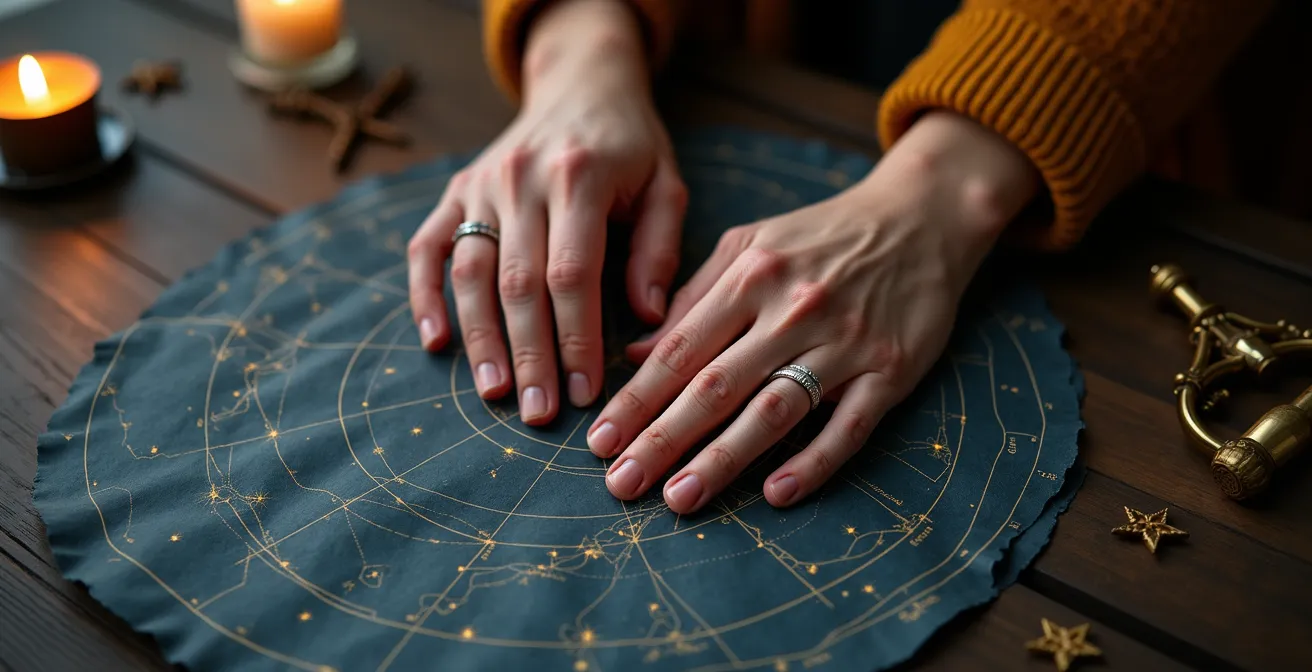
Finding a compatible partner isn’t about matching sun signs; it’s about mastering the internal conflicts your birth chart reveals.
- Your deepest emotional needs (Moon) must be met before your romantic desires (Venus) can be truly satisfied.
- Difficult ‘square’ aspects are not curses, but sources of ‘creative tension’ that fuel personal growth and break karmic cycles.
Recommendation: Start by identifying the ruler of your 7th house—it reveals the blueprint of the partner you unconsciously seek to complete your story.
If you feel like you’re living in a relationship loop—attracting the same type of person, facing the same conflicts, and arriving at the same painful conclusion—you are not alone. It’s a common human experience, especially for those of us in our 30s and beyond who are seeking more than just fleeting romance. You’ve likely looked to astrology for answers, perhaps checking your Venus sign or running compatibility reports. While these are valid starting points, they often only scratch the surface, failing to explain the persistent ‘why’ behind your recurring patterns.
The truth is that your birth chart is less of a romantic compatibility tool and more of a profound psychological map. It details the internal tensions, disowned traits, and core needs that you unconsciously project onto your partners. The people we attract are not random; they are messengers, arriving to play out a script that is written entirely within us. The key to breaking the cycle isn’t about finding a person with the ‘perfect’ chart. It’s about becoming conscious of your own inner dynamics and learning to integrate them.
This guide will move beyond simplistic sign-matching. We will explore the key pillars of your relational blueprint: the director of your partnership story (your 7th House Ruler), the conflict between core needs and superficial wants (Moon vs. Venus), the hidden potential in your most challenging aspects, and the cosmic timing that signals when you’re truly ready for change. By the end, you will have a framework for self-understanding that empowers you to stop repeating the past and start creating the future you desire.
This article provides a structured path to decode your relationship blueprint. The following summary outlines the key areas we will explore to help you gain clarity and begin your journey toward more fulfilling connections.
Summary: How to Read Your Natal Chart to Understand Relationship Patterns
- Why Your 7th House Ruler Defines Your Ideal Partner Traits?
- How to Decode Your Venus Sign to Find True Satisfaction?
- Moon Needs vs Venus Wants: Which Should You Prioritize in Love?
- The Self-Sabotage Traps Hidden in Your Square Aspects
- When to Start Dating Again Based on Your Current Transits?
- Why Your Sun Sign Represents Your Ultimate Hero’s Journey?
- Why Fire and Water Signs Struggle to Find Emotional Safety?
- Moon Signs Compatibility: The Secret to Emotional Security?
Why Your 7th House Ruler Defines Your Ideal Partner Traits?
While the 7th House itself describes the *arena* of your one-on-one partnerships, its ruling planet is the true director of the show. This planet, and the house it resides in, reveals the unconscious archetype you are drawn to and the life themes that your significant relationships will activate. It’s the “who” and “where” of your partnership story. For example, if your 7th house is in Aries (ruled by Mars) and Mars is in your 10th house of career, you will consistently attract ambitious, driven, and perhaps competitive partners, and your relationships will be intrinsically linked to your public life and professional goals.
Understanding this placement is the first step in making the unconscious conscious. It explains why you might repeatedly attract partners who need saving (ruler in the 12th house) or partners who stimulate your mind but remain emotionally distant (ruler in the 3rd house). The key isn’t to fight this pattern, but to understand what it’s trying to teach you about the part of your own life you are being asked to develop through another person. This dynamic isn’t limited to romantic love, as it often manifests powerfully in business partnerships as well.
Case Study: Steve Jobs’ 7th House Ruler in the 2nd House
A classic example of this principle is Steve Jobs. His 7th house ruler was located in his 2nd house of values, assets, and material wealth. As a result, his most significant partnerships were fundamentally tied to building tangible value and financial success. His groundbreaking partnership with Steve Wozniak at Apple is a perfect illustration of how this placement manifests: the relationship directly served the purpose of creating immense material wealth and valuable products. This placement in his chart, as detailed in astrological analyses of his chart, shows that his partnerships were a primary vehicle for achieving his financial and material ambitions.
By identifying your 7th house ruler’s sign and house placement, you gain a powerful lens through which to view your relationship history. You begin to see the underlying theme, the consistent role you ask your partners to play, and the part of your own life you are seeking to activate through them. This awareness is the first step toward conscious partnership.
How to Decode Your Venus Sign to Find True Satisfaction?
Venus is the planet of love, beauty, and pleasure. It governs what we find attractive, our social graces, and our romantic style. However, reducing Venus to just “what you like” misses its profound dual nature. Every Venus sign has both a satisfied, high-vibration expression and a shadow expression that emerges when its core desires are unmet. Understanding this spectrum is crucial to diagnosing dissatisfaction in your love life. A Venus in Leo, for example, is warm, generous, and creatively expressive when its need for appreciation is met. When ignored, it can become attention-seeking, dramatic, and demanding, sabotaging the very connection it craves.
Decoding your Venus requires an honest look at both its light and shadow potentials. It’s about recognizing when you are operating from a place of authentic pleasure and when you are driven by a fear-based need for validation. The journey with Venus is learning to provide its needs for yourself first—to embody the beauty, harmony, and worth you seek in another.

As this visual suggests, the energy of Venus is a spectrum. When you feel seen and valued, your Venus radiates its brightest qualities. When you feel unappreciated, that same energy can curdle into its shadow form. True satisfaction comes not from a partner perfectly fulfilling your Venusian checklist, but from developing a relationship where you feel safe enough to express its full range and are empowered to meet your own desires.
The following table, based on common interpretations found in resources like a guide to reading birth charts for love, can serve as a powerful tool for self-reflection. Identify your Venus sign and honestly assess which column more accurately reflects your typical experience in relationships. This is your starting point for understanding what truly needs to change.
| Venus Sign | When Satisfied | Shadow Side (When Needs Unmet) |
|---|---|---|
| Venus in Aries | Passionate, direct, adventurous in love | Impatient, aggressive, selfishly demanding |
| Venus in Taurus | Loyal, sensual, provides stability | Possessive, stubborn, materialistic |
| Venus in Gemini | Communicative, playful, intellectually stimulating | Superficial, inconsistent, emotionally detached |
| Venus in Cancer | Nurturing, emotionally supportive, protective | Clingy, moody, emotionally manipulative |
| Venus in Leo | Generous, warm, creatively expressive | Attention-seeking, dramatic, prideful |
| Venus in Virgo | Devoted, helpful, practical support | Critical, perfectionist, emotionally withholding |
| Venus in Libra | Harmonious, fair, romantically attentive | Conflict-avoidant, people-pleasing, indecisive |
| Venus in Scorpio | Deeply passionate, transformative, loyal | Jealous, manipulative, suspicious |
| Venus in Sagittarius | Adventurous, optimistic, growth-oriented | Commitment-phobic, restless, tactless |
| Venus in Capricorn | Committed, responsible, provides structure | Cold, calculating, status-obsessed |
| Venus in Aquarius | Independent, unique, intellectually stimulating | Emotionally distant, rebellious, unpredictable |
| Venus in Pisces | Compassionate, romantic, spiritually connected | Escapist, victim mentality, boundary-less |
Moon Needs vs Venus Wants: Which Should You Prioritize in Love?
Here lies one of the most critical distinctions in relationship astrology: the difference between your Moon and your Venus. Venus represents your wants—the romantic ideals, the aesthetic pleasures, and the qualities that spark attraction. Your Moon, however, represents your needs—your non-negotiable requirements for emotional safety, security, and belonging. It’s the child within you, your instinctual self. A repeating pattern of unsatisfying relationships often stems from prioritizing Venus wants over Moon needs. You might be attracted to a partner who perfectly matches your Venus in Sagittarius’s desire for adventure and freedom, but who constantly triggers your Moon in Cancer’s deep need for consistent reassurance and a safe home base.
A relationship can survive an unfulfilled Venus, but it cannot survive a starved Moon. When your core emotional needs are not met, you will feel perpetually anxious, insecure, and emotionally empty, no matter how exciting or attractive the partnership appears on the surface. The path to a healthy relationship involves first understanding your own Moon sign and its requirements for safety. Then, you must learn to communicate these needs clearly and choose partners who are capable and willing to meet them. Emotional sovereignty—the ability to recognize and honor your own emotional foundation—is the ultimate goal.
Case Study: Balancing Venus in Sagittarius with Moon in Taurus
Consider a person with Venus in Sagittarius, who wants freedom, travel, and philosophical exploration. Their Moon, however, is in Taurus, which needs stability, predictability, and sensory comfort. This creates a powerful internal conflict. They are drawn to nomadic, free-spirited partners (Venus) who ultimately make them feel deeply insecure (Moon). The resolution is not to sacrifice one for the other, but to seek integration. A successful partner for this individual might be someone with a secure career who also loves to plan international trips together—a stable ‘home base’ from which they can adventure. The key is finding a partner who doesn’t trigger the Moon’s fundamental insecurity while still honoring Venus’s desire for growth and expansion.
You can use this understanding as a filter when dating. A strong Venus connection creates chemistry, but a strong Moon connection creates a home. When you meet someone new, observe how your body and emotions react. Do you feel a thrilling spark (Venus), or do you feel a sense of calm and safety in your nervous system (Moon)? The latter is the true green flag for long-term potential.
The Self-Sabotage Traps Hidden in Your Square Aspects
In astrology, ‘hard aspects’ like squares (planets 90 degrees apart) are often seen as sources of trouble and conflict. This is a limited perspective. A more empowering view is to see them as points of creative tension and immense energy. A square in your chart represents two parts of your personality that operate on different wavelengths and create internal friction. This friction demands resolution. If you don’t consciously work to integrate these energies, you will unconsciously project one side of the conflict onto a partner, creating the very “self-sabotage” cycles you seek to break. For example, a square between Venus (love) and Saturn (duty) can manifest as a pattern of attracting emotionally unavailable partners who force you to choose between love and responsibility.
The trap is believing the problem is external. The gift is realizing the square is an engine for growth. By consciously working with the tension—for instance, by setting clear boundaries (Saturn) in your relationships (Venus)—you integrate the energies internally. This stops the projection and transforms the pattern. Your chart’s squares are not your fate; they are your assignment. They point directly to the work you need to do to achieve mastery in your life and relationships. As some astrologers note, we often encounter these challenging parts of ourselves in others.
When we meet our twelfth house in others, we are less apt to jump up and declare that person ‘the one’ like we might do if we meet our seventh house in a person. Instead, we might feel uncomfortable in their presence, but somehow drawn to the experience.
– Cafe Astrology, Relationship Potential in a Natal Chart
This principle of projection is especially potent with difficult aspects. The discomfort they create when mirrored by a partner is a signpost, pointing you back to the integration work within yourself.
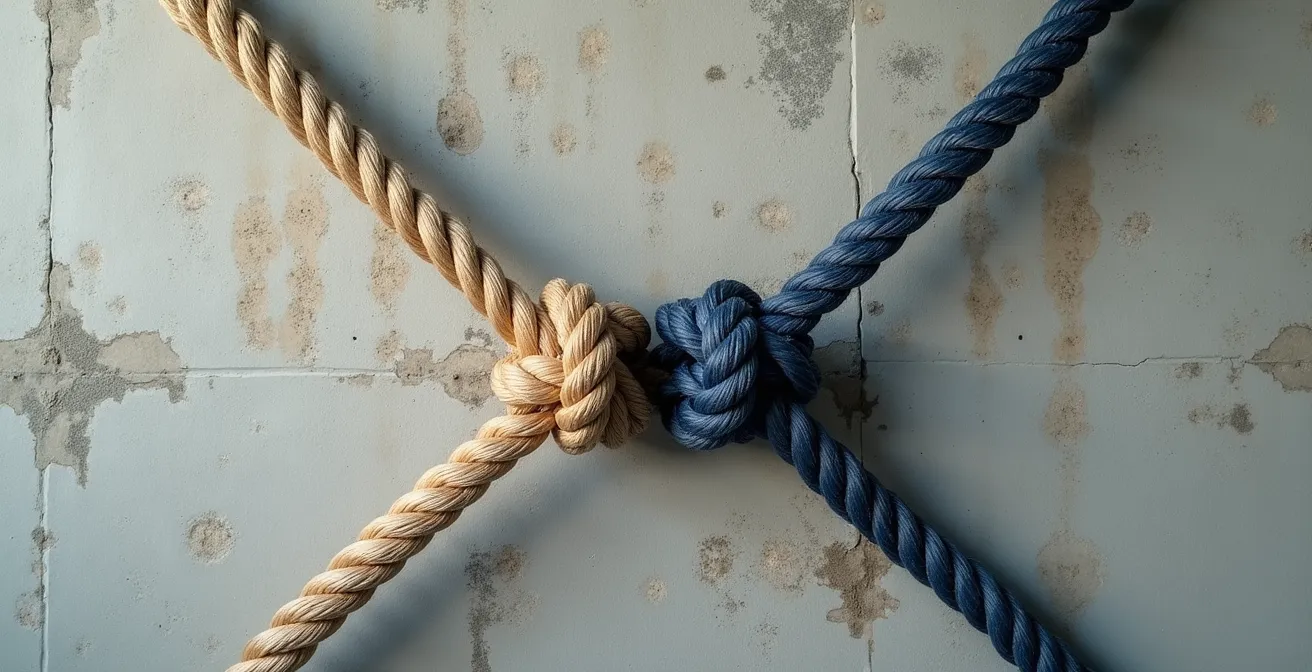
Think of your square aspects like these ropes. They are taut and under pressure, but their interwoven connection creates a structure that is incredibly strong. Your work is not to cut one of the ropes, but to understand how their opposing pulls can be harnessed to create balance and resilience. Embracing this creative tension is how you turn a source of self-sabotage into a source of profound personal power.
When to Start Dating Again Based on Your Current Transits?
After a period of introspection and healing, the question of “when” to re-enter the dating world often arises. Astrology offers a powerful tool for this: transits. Transits are the ongoing movements of the planets as they interact with your natal chart, creating “cosmic weather” that is more favorable for certain activities. Dating during supportive transits can feel like swimming with the current, while dating under challenging ones can feel like an uphill battle. It’s not about waiting for a “perfect” time, but about aligning your actions with the prevailing cosmic energy.
For example, a Jupiter transit to your 7th house is a classic time for expansion in relationships, making it ideal for meeting new people and being open to different types of partners. Conversely, a Saturn transit to your Venus might feel restrictive, but it’s the perfect period for “serious dating”—focusing on commitment, boundaries, and long-term compatibility. Understanding the nature of your current transits allows you to form a strategy. You can decide whether it’s a time for exploration, for deep healing, or for making a serious commitment. This knowledge moves you from a passive participant to a conscious co-creator of your love life.
One key cycle to watch is that of the Progressed Moon. According to astrological progression cycles, approximately every 2.5 years, the Progressed Moon changes signs, which signals a fundamental shift in your emotional needs and focus. Starting to date just as your Progressed Moon enters a new sign can align your efforts with your evolving inner landscape. The key is to see these transits not as predictive fate, but as a strategic guide.
Here is a simplified guide to leveraging major transits for your dating strategy:
- Saturn transit to Venus: The “Serious Dating” window. Focus on long-term compatibility, clear boundaries, and discussions about commitment.
- Jupiter transit to 7th house: The “Exploratory Dating” phase. Cast a wider net, be open to partners from different backgrounds, and embrace opportunities.
- Venus Return (yearly): A natural reset point. Use this time to review what you want and need in love, and set new intentions.
- North Node transit to 7th house: The “Fated Encounter” window. Stay particularly open to new connections, as they may have a karmic or destiny-driven quality.
- Pluto transit to Venus: A period of deep transformation. It’s best to focus on healing old relationship wounds and patterns before actively dating.
- Uranus transit to 7th house: Expect the unexpected. Be open to unconventional relationships or sudden changes in your partnership status.
Why Your Sun Sign Represents Your Ultimate Hero’s Journey?
Your Sun sign is far more than a simple personality descriptor; it represents your core identity, your vitality, and the central theme of your life’s “hero’s journey.” It is the energy you are here to consciously develop and shine into the world. In the context of relationships, your Sun sign reveals the role you are meant to play and the kind of recognition you need to feel alive and seen. A healthy partnership is one where your partner not only accepts but actively champions your Sun’s expression, creating a stage where you can perform your heroic role.
When you find yourself in relationships that make you feel small, unseen, or forced to betray your core nature, it’s often a sign of a conflict with your Sun’s journey. For example, a Leo Sun needs a partner who celebrates their creativity and leadership, not one who is threatened by their light. A Capricorn Sun needs a partner who respects their ambition and discipline, not one who dismisses it as being “all work and no play.” The relationship becomes a testing ground for the mature expression of your Sun. Does it help you evolve from an immature Aries’ impulsiveness to a mature Aries’ courage? From a shadow Virgo’s criticism to a healthy Virgo’s helpful service?
Ultimately, a successful long-term partnership supports both individuals’ heroic journeys. It’s a union where both people feel more like themselves, not less. Assessing your past and present relationships through this lens can be incredibly revealing. Ask yourself: “In this connection, do I feel more or less like the hero of my own story?” The answer will tell you much of what you need to know about the alignment of the relationship with your soul’s purpose.
Use this checklist to reflect on how your partners have supported or hindered your Sun’s expression:
- Reflect on your last three partners: Did they generally make you feel more like your Sun sign’s best expression, or its shadow side?
- Does your current or ideal partner champion your core identity and the qualities of your Sun sign?
- Do they support your activities and goals in the area of life represented by your Sun’s house placement (e.g., career for the 10th, home for the 4th)?
- Do conflicts often arise because your partner challenges the healthy expression of your ego and identity?
- Does the relationship help you evolve your Sun’s expression from its immature form to its mature potential (e.g., from prideful Leo to generous Leo)?
Why Fire and Water Signs Struggle to Find Emotional Safety?
The elemental combination of Fire (Aries, Leo, Sagittarius) and Water (Cancer, Scorpio, Pisces) is one of the most dynamic and potentially volatile in the zodiac. This pairing brings together action, passion, and enthusiasm (Fire) with emotion, intuition, and sensitivity (Water). The core conflict is simple: Fire acts, while Water feels. Fire expresses emotion outwardly and quickly, while Water processes it inwardly and deeply. This fundamental difference can create a constant struggle for emotional safety. The Water sign may feel their emotional depths are dismissed or ignored by the Fire sign’s need for immediate action, while the Fire sign can feel bogged down or manipulated by the Water sign’s emotional complexity.
This “boiling water” or “extinguished fire” dynamic often plays out in predictable patterns. For example, a Cancer partner expresses a vulnerability, and their Aries partner immediately jumps to “fix it” with a solution, when all the Cancer needed was to be held in their feeling. The Aries feels rejected, and the Cancer feels misunderstood. The key to making this combination work is for both partners to honor the other’s elemental nature without trying to change it. Fire must learn to slow down and create space for feelings, and Water must learn to appreciate Fire’s intent to protect and act, even if the method is clumsy.
The Steam Metaphor: Creating Transformative Energy
When Fire and Water signs learn to work together, they don’t neutralize each other; they create ‘steam’—a powerful, transformative energy that combines passion with healing. Consider a Cancer-Sagittarius couple who felt perpetually stuck. The Cancer felt the Sagittarius was emotionally shallow, and the Sagittarius felt the Cancer was a ‘wet blanket’ on their adventures. Their breakthrough came when they established a ritual. The Cancer partner would first express their emotional needs (Water), and only then would the Sagittarius partner suggest an active, adventurous solution (Fire). The Cancer’s depth gave meaning to the Sagittarius’s adventures, while the Sagittarius’s optimism helped pull the Cancer out of their emotional shell. They created steam, an energy that moved them both forward.
The modality (Cardinal, Fixed, Mutable) of the signs involved adds another layer of complexity to this dynamic, defining the specific flavor of the power struggle. Understanding these patterns allows couples to move from conflict to conscious integration.
| Modality Combination | Signs Involved | Core Conflict Pattern | Integration Path |
|---|---|---|---|
| Cardinal Fire/Water | Aries & Cancer | Initiating conflict – who leads emotionally? | Take turns initiating, respect different leadership styles |
| Fixed Fire/Water | Leo & Scorpio | Deep power struggle over emotional control | Share vulnerability, alternate who holds space |
| Mutable Fire/Water | Sagittarius & Pisces | Scattered energy vs emotional overwhelm | Create boundaries while maintaining flexibility |
Key Takeaways
- Your non-negotiable emotional needs (Moon sign) must be prioritized over your romantic desires (Venus sign) for long-term security.
- The planet ruling your 7th house, and the house it’s in, provides a detailed blueprint of the partner archetype you unconsciously seek.
- Challenging ‘square’ aspects are not curses but opportunities for growth, pointing to the internal integration work needed to break karmic patterns.
Moon Signs Compatibility: The Secret to Emotional Security?
If there is a single “secret” to long-term relationship success in astrology, it lies with the Moon. While Venus governs attraction and the Sun governs identity, the Moon governs the very foundation of the bond: emotional security. Moon sign compatibility is not about having the same Moon sign; it’s about understanding and being able to naturally “feed” your partner’s emotional needs, and vice versa. It’s the unspoken language of care. When you intuitively know how to soothe your partner’s anxieties and they know how to make you feel safe, you have the bedrock for a lasting connection.
Each element expresses its emotional needs differently. Earth Moons (Taurus, Virgo, Capricorn) need tangible security and practical acts of service. Air Moons (Gemini, Libra, Aquarius) need mental space and verbal communication. Water Moons (Cancer, Scorpio, Pisces) need emotional depth and a safe container for their feelings. Fire Moons (Aries, Leo, Sagittarius) need freedom to express their passions and support for their actions. A mismatch in these core needs can lead to constant friction, where one partner’s way of showing love is not received or understood by the other.
The most profound connection you can build is one where you feel your deepest, most vulnerable self (your Moon) is safe, seen, and cherished. This goes beyond what is said and is felt on an instinctual level. It’s the feeling of “coming home.” Looking beyond individual charts, advanced techniques reveal that the Composite Moon represents the emotional personality of the relationship itself, offering a deeper look into the shared emotional world you build together.
Action Plan: How to Feed Your Partner’s Moon Sign
- EARTH MOON (Taurus, Virgo, Capricorn): Provide physical comfort through touch, cook their favorite meals, be consistently reliable, and engage in practical, real-world activities together. Stability is their love language.
- AIR MOON (Gemini, Libra, Aquarius): Give them mental space to process feelings, talk through things logically without emotional pressure, respect their need for social connections, and never dismiss their ideas as “just thoughts.”
- WATER MOON (Cancer, Scorpio, Pisces): Create emotional safety through deep, non-judgmental listening, honor their intuition, provide a sanctuary space at home, and validate their feelings without immediately trying to fix them.
- FIRE MOON (Aries, Leo, Sagittarius): Support their need for action when they’re upset, celebrate their wins enthusiastically, give them the freedom to express big emotions without making them feel like “too much,” and join them in physical activities.
- Self-Audit: Reflect on your own Moon sign. Are you clearly communicating these needs to your partner, or are you expecting them to guess? True security is co-created.
By learning to speak your partner’s lunar language, you move beyond the surface of compatibility and begin to build a true emotional sanctuary. This conscious nurturing is the ultimate expression of love.
To apply these insights, the next logical step is to obtain a personalized reading of your birth chart. This will allow you to begin the profound journey of conscious relating, armed with a deeper understanding of your own unique psychological and emotional landscape.