
Reading subtle energy is not a magical gift but a learnable sensory skill, achievable by calibrating your body to detect and interpret environmental and biological frequencies.
- Geopathic stress from the earth and emotional imprints in a home create tangible energy disturbances that can impact well-being.
- Your body acts as the primary instrument; proper posture, mental detachment, and ethical intent are non-negotiable for an accurate reading.
Recommendation: Begin by mastering environmental scanning with L-Rods to map large areas before moving to the pinpoint diagnostic work of a pendulum on personal auras or chakras.
The space around you is not empty. It is a dense matrix of overlapping energy fields, from the earth’s own magnetic grid to the subtle bio-field that surrounds every living being. For healers, home buyers, and the energetically sensitive, these invisible forces are not abstract concepts; they are palpable realities that can influence health, mood, and harmony. The common approach to dowsing often remains superficial, focusing on simple “yes/no” questions. This reduces a profound sensory art to a mere party trick, ignoring the rich tapestry of information available.
What if the true purpose of dowsing wasn’t just to get an answer, but to learn a new language? This isn’t about channeling spirits or predicting the future. It’s about sensory calibration. It is the process of training your nervous system, with the help of a tool like an L-rod or a pendulum, to act as a sensitive antenna. This antenna doesn’t receive magical signals; it registers subtle shifts in electromagnetic and vibrational frequencies that are constantly present but usually below the threshold of our normal perception.
This guide moves beyond the basics. We will explore how to detect the specific signature of geopathic stress lines that can affect well-being. We will detail the protocol for scanning a person’s aura to find energetic deficiencies, differentiate the roles of L-Rods and pendulums for field work, and address the critical physical and mental preparations required for a pure, unbiased reading. By treating dowsing as a technical, sensory discipline, you can transform it from a game of chance into a reliable diagnostic tool.
This article provides a structured framework for developing your dowsing capabilities, moving from large-scale environmental analysis to a detailed diagnosis of the human energy system. The following sections will guide you through the essential principles and techniques to become a proficient energy scanner.
Summary: A Sensory Guide to Dowsing Energy Fields
- Why Geopathic Stress Lines Can Make You Sick?
- How to Scan a Person’s Aura to Find Energy Holes?
- L-Rods or Pendulum: Which is Better for Field Work?
- The Mistake of Crossing Your Legs While Reading Energy
- How to Detach Mentally to Get a Pure Reading?
- How to Scan Your Chakras to Find the Root of Physical Pain?
- Why Secrets Create Physical Tension in a Shared Home?
- Top 5 Healing Crystals for Holistic Physical and Mental Wellness
Why Geopathic Stress Lines Can Make You Sick?
Geopathic stress refers to the distorted or disrupted electromagnetic energy emanating from the Earth. These disturbances can be caused by underground water veins, mineral concentrations, or fault lines, but the most pervasive are natural grid systems like the Hartmann and Curry lines. When these lines intersect, they create nodes of concentrated, often dissonant, energy. Prolonged exposure to these nodes, especially in areas where you spend significant time like your bed or office chair, can place a constant, low-level strain on the body’s cellular and nervous systems. This is not a mystical belief; some researchers have drawn alarming connections. For instance, Austrian research has suggested a correlation between long-term exposure to geopathic stress zones and the development of chronic illnesses.
Your body intuitively registers this energetic dissonance, often manifesting it as poor sleep, chronic fatigue, a weakened immune system, or a persistent feeling of being “unwell” in your own home. The dowsing rod acts as an amplifier for this subtle perception. As you walk over a geopathic signature, your body’s own bio-field interacts with the distorted field from the earth. This interaction creates a minute neuromuscular response in your arms, which the L-rods then make visible by crossing or diverging. Differentiating between a Hartmann line, a water vein, or a simple emotional imprint requires a systematic dowsing protocol, moving from general scanning to specific diagnostic questions to pinpoint the exact nature of the stress.
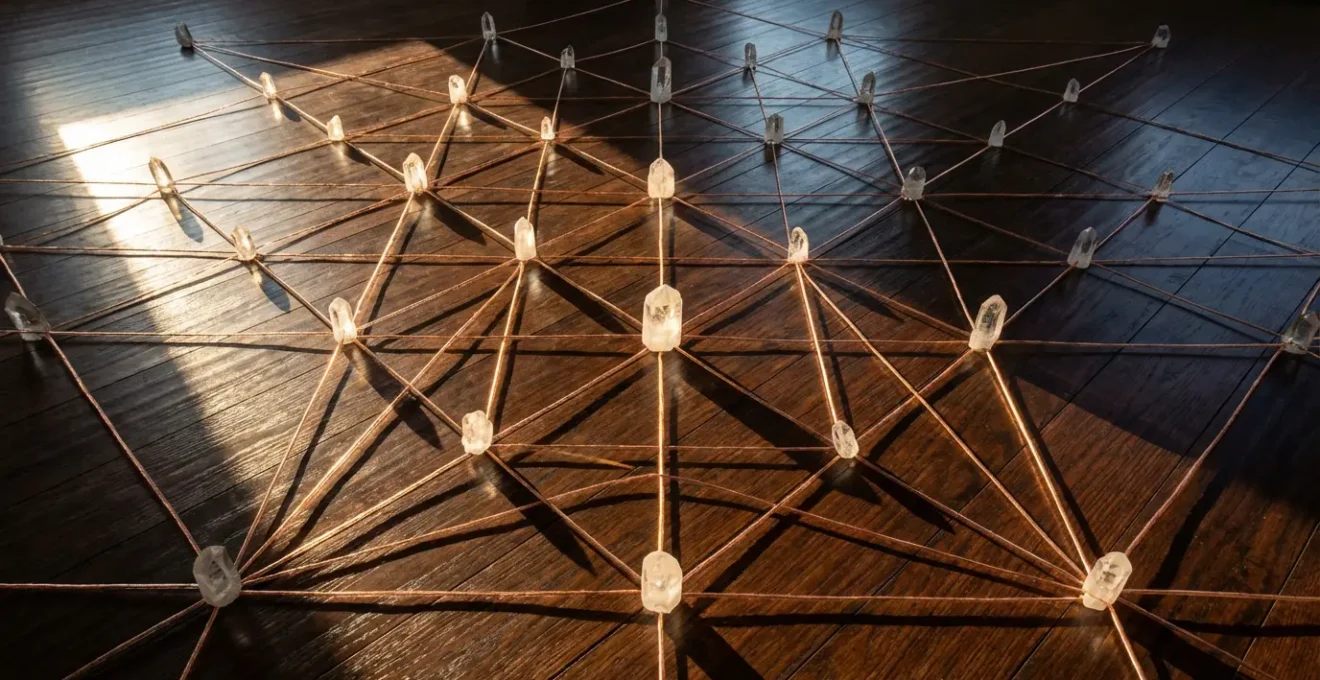
As visualized above, these invisible energy grids form a complex pattern within a living space. Identifying where the most intense intersections occur is the primary goal of a geopathic survey. By mapping these zones, you can make simple but profound adjustments, such as moving a bed or desk a few feet, to shift your body out of the direct path of chronic energetic stress. This is the foundational step in creating a harmonically supportive environment, as clearing personal energy is futile if the space itself is a source of constant disruption.
How to Scan a Person’s Aura to Find Energy Holes?
Scanning a person’s aura, or bio-field, is a shift from environmental dowsing to interpersonal diagnostics. The aura is a multi-layered field of energy surrounding the body, and its state reflects physical, emotional, and mental health. “Energy holes,” or areas of depletion, feel like voids or cold spots to a trained hand and register as a specific response on a pendulum. These depletions can indicate where a person is losing vital energy, often corresponding to a physical ailment or an emotional trauma. The first rule of this practice is ethical: as a professional healer would, you must always seek clear and explicit permission before scanning someone’s energy field. This is a matter of respect for personal boundaries and energetic sovereignty.
To begin a scan, have the person stand in a relaxed, open posture. Using a pendulum, you will methodically sweep it through the layers of their aura, typically starting about two feet away from the body and moving closer. You are not looking for a “yes” or “no”; you are observing the pendulum’s physical behavior. It becomes an indicator of field density and flow. As the Love & Light School of Crystal Therapy notes in its guide on energy reading:
The pendulum may remain still for stagnant energy or swing wildly to show that the energy is concentrated in a particular spot.
– Love & Light School of Crystal Therapy, Using Crystal Pendulums: Dowsing for Wisdom & Energy Reading
An “energy hole” will typically cause the pendulum to stop swinging completely or to exhibit a weak, erratic flutter. This signifies a lack of coherent energy. When you find such a spot, you can hold the pendulum steady over it and ask diagnostic questions like, “Is this related to a physical issue?” or “Is there an emotional block here?” The subsequent “yes” or “no” swing will provide deeper insight. This process of bio-field mapping allows you to create a detailed chart of a person’s energetic anatomy, highlighting areas that require healing and support long before they manifest as severe physical symptoms.
L-Rods or Pendulum: Which is Better for Field Work?
Choosing between L-Rods and a pendulum isn’t about which is “better,” but which is the right tool for the specific task. They are analogous to using a wide-beam flashlight versus a laser pointer. L-Rods are the premier tool for large-scale field work, such as mapping property lines, tracing underground water veins, or identifying the general location of geopathic stress zones in a house. Their design allows them to respond to broad shifts in the environmental energy field as you walk. They excel at answering the question “Where?” by physically pointing you in a direction or crossing to mark a specific line or zone. They are less effective for detailed diagnostics.
The pendulum, conversely, is a tool for pinpoint accuracy. Once an L-rod has identified a general area of disturbance, you switch to the pendulum for a precise diagnosis. Held stationary over a single point, it can answer specific “yes/no/maybe” questions, determine the direction of energy flow (clockwise for positive/masculine, counter-clockwise for negative/feminine), and measure the intensity or health of a specific point like a chakra. Its compact nature makes it highly portable and less susceptible to wind than L-Rods, but it is impractical for scanning a large area. The key to efficient dowsing is a hybrid approach: use the L-Rods to find the “what” and “where” on a macro level, then use the pendulum for the “why” and “how deep” on a micro level.
This comparative analysis highlights the distinct strengths of each tool, guiding the dowser in selecting the most effective instrument for their objective. The following table, based on insights from dowsing practitioners, summarizes these differences:
| Aspect | L-Rods | Pendulum |
|---|---|---|
| Best Use | Large area scanning, field boundaries | Pinpoint accuracy, specific queries |
| Coverage | Dynamic mapping of energy zones | Focused diagnosis of single points |
| Sensitivity | Responds to broad environmental energies | Detects subtle personal energy shifts |
| Portability | Requires more space to operate | Compact, fits in pocket |
| Learning Curve | Moderate – body positioning crucial | Easy – simple yes/no responses |
| Weather Impact | Wind can affect readings | More stable in outdoor conditions |
The Mistake of Crossing Your Legs While Reading Energy
The most common and critical mistake a novice dowser makes is ignoring their own body. Your dowsing tool is merely an indicator; your body is the true instrument. It is the antenna that receives the subtle energy signal, and your nervous system translates that signal into the micro-muscular movements that make the tool move. When you cross your legs or arms, you are effectively short-circuiting your own system. You create a closed energetic loop, blocking the natural flow of energy from the earth up through your body and out through your hands. This compromises the clarity and reliability of any reading you attempt to take.
Achieving a state of sensory calibration requires an open and grounded posture. Stand with your feet shoulder-width apart, knees slightly bent, and your weight distributed evenly. Your spine should be straight but not rigid, and your arms should hang loosely at your sides when not holding the tools. This posture turns your body into an open conduit, allowing you to connect to the Earth’s field (grounding) and simultaneously be receptive to the ambient energies you wish to read. Before any dowsing session, it is crucial to perform a brief body preparation routine: remove metal jewelry, shake out your hands to activate energy flow, and take several deep breaths to center yourself. You are not just preparing a tool; you are tuning your own biological instrument.

This image demonstrates the ideal state of physical receptivity. The dowser is not a passive observer but an active participant in an energetic circuit with the environment. Every aspect of their posture is designed to maximize sensitivity and minimize interference. By maintaining this open stance, you ensure that the movements of your rod or pendulum are a true reflection of the external energy field, not the garbled feedback of your own blocked internal circuit.
How to Detach Mentally to Get a Pure Reading?
After mastering physical posture, the next barrier to a pure reading is the mind. The pendulum or L-rod will respond to what you want it to find just as easily as it will respond to what is actually there. This is the primary reason dowsing is often dismissed; the dowser’s own desire, expectation, or fear biases the result. True mental detachment is not about having an “empty mind,” which is nearly impossible. Instead, it is the practice of becoming a neutral observer of your own internal process. You must learn to ask a question without being invested in the answer.
A powerful technique used by professional dowsers to cultivate this detachment is the use of blind testing protocols. For example, when dowsing for a client’s food sensitivities, instead of asking “Is this person sensitive to wheat?” (a question loaded with potential pre-conceptions), the names of different foods are written on identical, folded pieces of paper. The dowser then scans each paper, asking a neutral question like, “Does the substance represented by this paper create a dissonant energetic response in this person’s field?” The dowser doesn’t know which paper corresponds to which food, removing conscious bias from the equation. This forces the response to come from a deeper, more intuitive level of perception, which is the core of an accurate reading.
Another advanced technique involves visualization. Before asking a question, visualize stepping outside of your own body and observing yourself as a third party. Ask the question from this “observer” perspective. This mental shift creates a psychological distance that helps neutralize emotional investment. You are no longer “you” asking a question; you are a researcher conducting an experiment. As noted by practitioners at the Wicca Academy, the goal is to attune the pendulum to your own energy while removing residual desires, ensuring the reading is pristine. This disciplined mental practice is what separates a novice from an expert dowser. It is the commitment to receiving pure data from the informational field, untainted by the noise of one’s own mind.
How to Scan Your Chakras to Find the Root of Physical Pain?
Chakras are concentrated energy centers within the bio-field that correspond to major nerve plexuses and endocrine glands. Each chakra governs specific physical, emotional, and psychological functions. When physical pain or a chronic condition arises, it is often preceded or accompanied by an imbalance—a blockage or over-activity—in the corresponding chakra. A pendulum is the ideal tool for this diagnostic work due to its ability to provide detailed feedback on a very specific point. By holding the pendulum over each of the seven major chakras, you can perform a full-body energy assessment.
The movement of the pendulum provides a clear language for the state of the chakra. A healthy, balanced chakra will produce a steady, medium-sized clockwise circle. A blockage or deficiency will result in a counter-clockwise swing, erratic movement, or no movement at all. Conversely, a large, fast clockwise circle indicates an overactive chakra, which can be just as problematic, often pointing to inflammation or hyperactivity in the related organs. As a practitioner, you are not just seeing movement; you are sensing the energetic resonance of that specific center.
The table below, based on established principles of crystal healing and dowsing, provides a guide for interpreting these movements:
| Pendulum Movement | Chakra State | Potential Physical Symptoms |
|---|---|---|
| Large clockwise circle | Overactive/Excessive energy | Tension, inflammation, hyperactivity in related organs |
| Small clockwise circle | Balanced, healthy flow | Good function of associated body systems |
| Counter-clockwise | Deficient/Blocked energy | Weakness, numbness, poor circulation in area |
| Erratic/Irregular swing | Disturbed/Chaotic energy | Intermittent pain, unpredictable symptoms |
| No movement | Severely blocked | Chronic conditions, long-standing issues |
| Side-to-side swing | Resistance/Protection | Body guarding area, defensive tension |
Once you identify an imbalanced chakra, the diagnosis can go deeper. You can use dowsing to investigate the root cause by asking temporal questions. This technique allows you to trace the origin of a block back through a person’s life to identify the initial trigger, which is essential for true healing.
Action Plan: Temporal Scan for Root Cause Discovery
- Identify the Imbalance: Hold the pendulum over the affected chakra and confirm the imbalanced state (e.g., counter-clockwise swing).
- Scan Major Life Periods: Ask specific yes/no questions: “Did this imbalance originate in childhood (0-12 years)?” “In adolescence (13-18)?” “In young adulthood (19-30)?” Note the first “yes” response.
- Narrow the Timeframe: Once a period is identified, get more specific: “Did this originate in the last 5 years?” “The last year?” “The last 6 months?”
- Identify the Trigger Type: Ask about the nature of the cause: “Was the root trigger primarily emotional?” “Was it related to physical trauma?” “Was it belief-based or ancestral?”
- Document the Narrative: Log all responses to create an energetic timeline. This pattern often reveals the story behind the physical symptom, providing a clear path for targeted healing work.
Why Secrets Create Physical Tension in a Shared Home?
A home is more than a physical structure; it is an energetic container that absorbs and holds the emotional states of its inhabitants. Strong, suppressed emotions—such as those associated with secrets, unspoken resentment, or grief—do not simply dissipate. They congeal into dense fields of stagnant energy, creating an almost tangible “heaviness” in a room. This is the informational field at work: the energy carries the data of the emotion. This isn’t just a poetic metaphor; research into environmental energies suggests that strong emotional disturbances can create a measurable electromagnetic field increase of over 70 nT (nano-Tesla) in a localized area.
This “place memory” creates a low-level but constant source of tension that everyone in the home subconsciously registers. It can manifest as irritability, arguments, or a feeling of never being able to fully relax in certain rooms. Dowsing with L-rods or a pendulum makes this phenomenon visible. You can literally map the emotional landscape of a home by walking through it and noting where your tools react. A study of energy clearing in homes after family counseling sessions where major secrets were revealed found that practitioners could consistently dowse these persistent heavy energy signatures. They were most often concentrated in bedrooms (60% of cases) and home offices (30%), the most private and emotionally charged spaces in a home.
The act of dowsing these areas does two things. First, it validates the feelings of the inhabitants, confirming that the “bad vibe” they feel is real. Second, it pinpoints the exact location of the stagnant energy, allowing for targeted clearing using methods like sound healing (Tibetan bowls), smudging (sage), or placing specific crystals. By identifying and neutralizing these pockets of suppressed emotional energy, you are not just “cleansing a space”; you are relieving a physical tension that has been imprinted on the environment, allowing for a lighter, more harmonious atmosphere for everyone within.
Key Takeaways
- Dowsing is a learnable sensory skill, not a psychic power. Your body is the instrument, and the tool is the indicator.
- Open posture is non-negotiable. Crossing your legs or arms blocks the energetic circuit and invalidates the reading.
- Mental detachment is crucial. Use blind testing or observer-perspective visualization to bypass conscious bias and get a pure signal.
Top 5 Healing Crystals for Holistic Physical and Mental Wellness
While dowsing is a powerful diagnostic tool, its utility extends into the therapeutic realm. Once you have identified an energy imbalance in a person or a space, the same dowsing skill can be used to select the most appropriate corrective tool, such as a healing crystal. Each crystal possesses a unique, stable crystalline structure that emits a specific, coherent frequency. The principle of energetic resonance states that a crystal’s frequency can interact with an imbalanced energy field, helping to restore it to a state of harmony. The five most essential crystals for a foundational wellness toolkit are typically regarded as Clear Quartz (the master healer), Amethyst (for calm and intuition), Rose Quartz (for emotional healing), Black Tourmaline (for grounding and protection), and Citrine (for energy and manifestation).
However, simply picking a crystal from a list is not the most effective approach. Your body’s needs change daily. The most potent method for selecting a crystal is to use a pendulum to test your personal resonance with it at that moment. By arranging a selection of crystals before you and holding the pendulum over each one, you can bypass your conscious mind and allow your body’s innate intelligence to show you which crystal’s frequency it needs most. State your intention, such as, “Show me the crystal that will best support my physical and mental wellness today.” A strong, wide, and steady clockwise swing over a particular crystal indicates a strong resonant match.
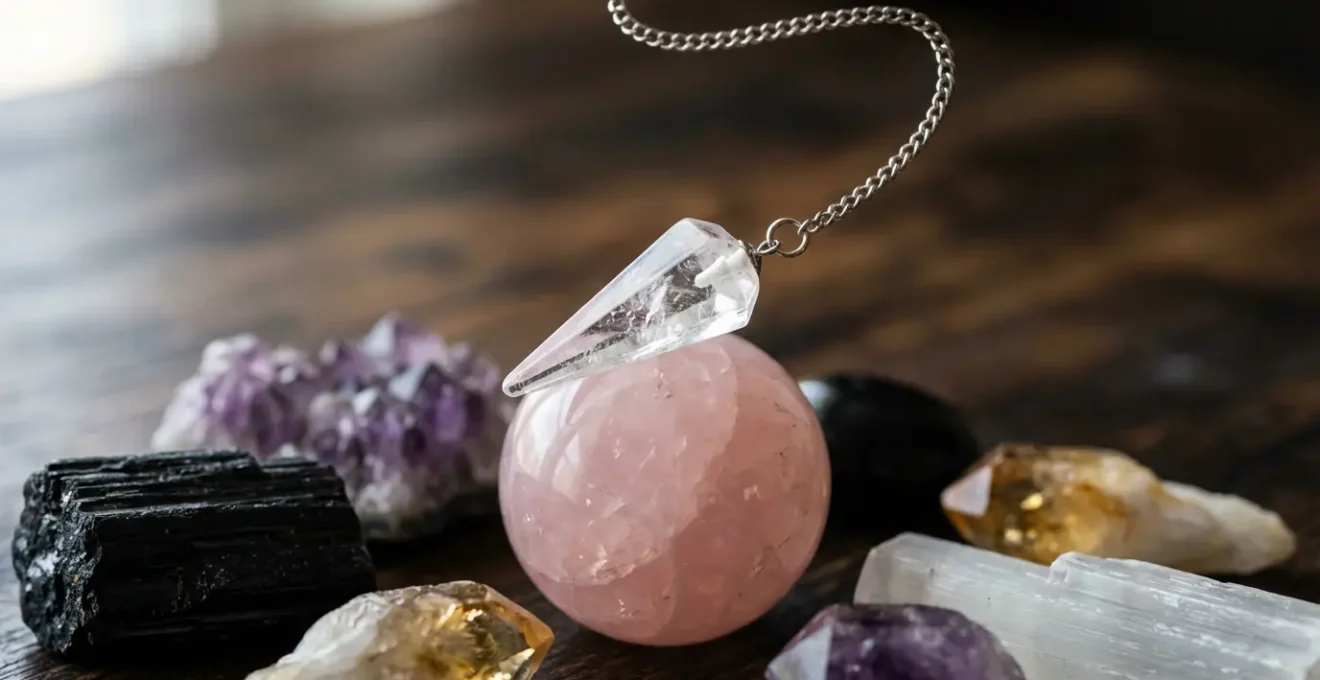
This process of dowsing for a crystal transforms crystal healing from a passive belief system into an active, personalized dialogue with your own energy field. It ensures that you are working with the precise vibrational medicine your body requires in that moment for holistic support. Once selected, the crystal can be carried, worn, or placed on the corresponding imbalanced chakra or in a specific area of your home to provide a continuous, stabilizing frequency, helping to gently untangle the energetic knots that dowsing helped you find.
By approaching dowsing as a technical, sensory discipline, you unlock a powerful capacity to perceive and interact with the world on a much deeper level. It is a journey of self-awareness and calibration. To truly integrate these skills, begin a consistent practice, starting with your own home and then, with permission, extending to friends and family. Keep a detailed journal of your findings, noting the tool’s movements, your sensory impressions, and any subsequent validations. This practice will build both your skill and your confidence, turning abstract theory into tangible results.