Esotericism & Traditions
Esotericism represents the hidden threads that connect spiritual practices across cultures and centuries. From the archetypal imagery of Tarot to the protective rituals passed down through generations, these traditions offer frameworks for understanding the invisible forces that shape our lives. Far from being relics of the past, esoteric knowledge provides practical tools for navigation—helping us decode relationship patterns, optimize our personal growth trajectory, and establish energetic boundaries in an increasingly chaotic world.
This exploration examines the core pillars of Western esoteric tradition, connecting timeless wisdom with contemporary practice. Whether you’re drawn to the symbolic language of cards, the evolutionary pull of lunar nodes, or the protective techniques that safeguard your energy field, understanding these foundations transforms curiosity into competence. Each tradition offers its own lens for perceiving reality, and together they form a comprehensive toolkit for the modern spiritual seeker.
Tarot Foundations and Reading Systems
Tarot serves as one of the most accessible entry points into esoteric study, yet its depth often surprises newcomers. The 78-card system functions as a symbolic language, with each card representing archetypal energies that appear across human experience. Understanding this language requires more than memorizing keyword lists—it demands engagement with the cards as living symbols that shift meaning based on context, position, and surrounding influences.
Traditional Systems and Deck Variations
The two dominant systems—Marseille Tarot and Rider-Waite-Smith—approach symbolism differently. Marseille decks emphasize geometric patterns and numerological correspondences, with pip cards (numbered cards) displaying simple suit arrangements rather than illustrated scenes. This stripped-down approach forces readers to develop intuitive connections rather than relying on pictorial cues. The Rider-Waite tradition, published in the early 20th century, added detailed imagery to every card, making meanings more immediately accessible but potentially limiting interpretive flexibility.
Choosing between these systems isn’t about finding the “correct” approach—it’s about understanding which symbolic vocabulary resonates with your cognitive style. Visual thinkers often gravitate toward illustrated pips, while those who appreciate mathematical patterns may find Marseille’s numerological emphasis more rewarding. Many experienced readers eventually work with multiple decks, recognizing that different systems illuminate different aspects of a question.
Symbolism and Interpretation Methods
The most common error in Tarot study is attempting to memorize fixed meanings rather than learning the symbolic language itself. The Tower doesn’t always mean disaster, and Death rarely predicts physical mortality. Context determines everything: a challenging card in a relationship reading might indicate necessary transformation, while the same card in a career spread could signal the collapse of an outdated professional identity.
Effective reading requires attention to several interpretive layers:
- Elemental associations: Wands (fire/action), Cups (water/emotion), Swords (air/thought), Pentacles (earth/material)
- Numerological significance: Aces signal beginnings, Fives indicate conflict, Tens represent completion
- Card combinations: How surrounding cards modify or amplify the central card’s message
- Directional cues: The gaze and body orientation of figures within illustrated cards
- Court card personalities: Pages (messengers/students), Knights (action/movement), Queens (internal mastery), Kings (external authority)
The Fool’s Journey—the sequential narrative from The Fool (0) through The World (XXI)—provides a master framework for understanding the Major Arcana as stages in spiritual development. Each card represents not just an event but a consciousness shift, a lesson that must be integrated before progression becomes possible.
Karmic Principles and Relationship Dynamics
Esoteric traditions consistently emphasize karmic equilibrium—the principle that energy exchanges must balance over time. In relationship contexts, this manifests as the law of reciprocity: what you give must be matched by what you receive, not in identical form but in equivalent energetic value. When this balance tips persistently in one direction, the relationship becomes a karmic drain rather than a mutually nourishing exchange.
The challenge lies in distinguishing healthy compromise from self-sacrificing patterns. Compromise involves both parties adjusting to create a third option that serves the relationship. Sacrifice, conversely, requires one person to consistently diminish their needs while the other remains unchanged. The savior complex—the compulsion to rescue others from consequences they’ve created—represents one of the most common karmic traps. This pattern often stems from past-life dynamics where caretaking provided safety or status, creating a soul template that persists beyond its usefulness.
Rituals for restoring balance range from simple (verbal boundary-setting paired with candle work) to complex (multi-day ceremonies involving planetary timing and specific offerings). The ritual itself matters less than the internal shift it catalyzes—the recognition that you have both the right and the responsibility to maintain energetic equilibrium. Without this balance, spiritual growth stagnates as your energy continually flows outward without replenishment.
Lunar Nodes and Evolutionary Astrology
The North and South Nodes of the Moon represent the soul’s evolutionary axis in a natal chart. The South Node indicates comfortable patterns developed through past experiences (whether interpreted as past lives or early childhood conditioning), while the North Node points toward growth that feels unfamiliar and often uncomfortable. This axis doesn’t suggest abandoning South Node gifts entirely—rather, it requires leveraging those established skills in service of North Node development.
The comfort zone trap occurs when we repeatedly retreat to South Node territory during stress. If your South Node falls in relationship-oriented Libra, you might habitually seek validation through partnership, even when growth requires developing the autonomous Aries qualities of your North Node. The pull is powerful because South Node behaviors feel natural and effortless—they’re well-worn neural pathways that activate automatically under pressure.
Key nodal transits include:
- Nodal Return (approximately age 18-19, 37-38, 56-57, 75-76): The nodes return to their natal positions, creating pivot points where life circumstances demand alignment with your evolutionary direction
- Nodal Opposition (approximately age 9, 28, 47, 66): The transiting nodes reverse their natal positions, often bringing external challenges that force evaluation of whether you’re honoring your growth path
- Eclipses on the nodal axis: Accelerated evolutionary pressure, often manifesting as sudden changes that redirect your trajectory
Ignoring the North Node’s call doesn’t prevent growth—it simply ensures that growth arrives through crisis rather than conscious choice. The universe has remarkable patience but absolute commitment to your evolution.
Protective Practices and Energy Boundaries
Energy protection represents one of the most practical applications of esoteric knowledge, yet it’s frequently misunderstood. Effective shielding doesn’t require fear or paranoia—in fact, fear-based protection often attracts the very energies it attempts to repel. The goal is establishing clear boundaries while maintaining openness to beneficial influences, much like a healthy cell membrane that selectively permits passage.
Daily Shielding Techniques
The bubble technique forms the foundation of most shielding practices. Visualize a sphere of light surrounding your body at arm’s length in all directions—above your head, below your feet, and encircling your sides. The key variables include:
- Color selection: White for general protection, gold for maintaining high vibration, mirror-silver for reflecting negativity, deep blue for emotional shielding
- Permeability: Semi-permeable (allows positive energy in/out) versus completely sealed (temporary use in hostile environments)
- Refresh frequency: Morning activation with periodic reinforcement in challenging situations
Layering shields provides more sophisticated protection. A base layer of white light establishes general boundaries, while a secondary mirror layer reflects targeted negativity, and an outer layer of specific color addresses particular vulnerabilities. This approach resembles the immune system’s multi-tiered defense rather than a single wall.
The reactive versus proactive distinction matters enormously. Reactive shielding—erected only when you sense attack—trains your energy field to remain vulnerable by default. Proactive shielding, incorporated into morning routines alongside brushing teeth, normalizes boundaries as a healthy baseline rather than an emergency measure.
Relationship-Specific Protection
Couples face unique energetic challenges as their fields naturally merge and interpenetrate. Defensive magic for relationships focuses less on shielding from your partner and more on protecting the partnership from external interference. The evil eye—envious attention that drains vitality—poses particular risks to visible happiness. Traditional Mediterranean and Middle Eastern cultures developed elaborate countermeasures, many involving salt (for purification and boundary-setting) and lemon (for cutting through negative attachments).
Bedroom boundaries deserve special attention. The sleeping state opens your energy field for processing and integration, making nighttime particularly vulnerable to unwanted influences. Simple protections include salt in room corners, protective symbols under the mattress, and establishing the bedroom as a technology-free sanctuary. Amulets (objects charged with protective intention) provide passive ongoing protection, while rituals (active ceremonial work) address acute situations requiring immediate intervention.
Ancient Wisdom and Esoteric Lineages
Historical esoteric systems provide the theoretical foundations that support practical techniques. The Emerald Tablet, attributed to Hermes Trismegistus, condenses Hermetic philosophy into cryptic verses—most famously “As above, so below,” which establishes correspondence between macrocosm and microcosm. This principle suggests that universal patterns repeat at every scale, from atomic structure to galactic organization, making it possible to understand vast cosmic processes through careful observation of immediate reality.
The Tree of Life from Kabbalistic tradition maps consciousness as ten interconnected spheres (sephiroth) arranged in three pillars. Each sphere represents a different aspect of divine emanation, from Kether (pure undifferentiated consciousness) through Malkuth (physical manifestation). Studying this diagram reveals how spiritual energy descends into material form and how practitioners can consciously ascend through meditation and ritual work.
The Western versus Eastern distinction in esotericism reflects fundamentally different philosophical orientations. Western traditions (Hermeticism, Kabbalah, ceremonial magic) typically emphasize individual will, symbolic systems, and active transformation of reality. Eastern approaches (Vedanta, Buddhism, Taoism) often prioritize dissolution of individual ego, direct experience beyond symbols, and acceptance of reality’s fundamental nature. Neither is superior—they represent different valid paths that appeal to different temperamental types.
Cultural appropriation concerns arise when practitioners extract techniques from living traditions without understanding their cultural context or supporting the communities that preserved them. Respectful engagement requires acknowledging lineage, studying traditions holistically rather than cherry-picking convenient elements, and recognizing that some practices remain closed to outsiders by design. Optimizing study time means going deep into fewer traditions rather than superficially sampling many.
Timing, Correspondences and Ritual Practice
Esoteric effectiveness multiplies when aligned with natural cycles and cosmic correspondences. Weekday astrology assigns planetary rulers to each day: Monday (Moon/emotion), Tuesday (Mars/action), Wednesday (Mercury/communication), Thursday (Jupiter/expansion), Friday (Venus/love), Saturday (Saturn/discipline), Sunday (Sun/vitality). Timing petitions and rituals according to these rulerships creates resonance between intention and cosmic energy flow.
The phrase “Saturday’s child works hard for a living” reflects Saturn’s association with effort, restriction, and earned achievement. Those born on Saturday often carry a karmic emphasis on discipline and delayed gratification. Rituals performed on the day matching your chart ruler (the planet ruling your Ascendant sign) carry particular potency, as they align personal identity with cosmic timing.
The relationship between day ruler and chart ruler creates nuanced timing opportunities. If your chart ruler is Venus but you’re working with Mars-ruled issues (conflict resolution, physical vitality), performing the work on Tuesday harmonizes the ritual with the immediate concern, while Friday work would harmonize with your fundamental nature. Neither is wrong—the choice depends on whether you’re addressing situational needs or deep identity-level transformation.
Ignoring cyclical timing doesn’t prevent results, but it requires more personal energy to overcome cosmic resistance. Working with the current rather than against it amplifies effectiveness while reducing exhaustion. This principle extends beyond daily correspondences to lunar phases (new Moon for beginnings, full Moon for culmination), planetary transits, and seasonal shifts.
As you explore these interconnected traditions, remember that intellectual understanding serves only as foundation. The esoteric reveals itself through practice—through daily card draws that gradually build symbolic fluency, through shielding exercises that teach you to sense your own energy field, through attention to nodal transits that illuminate your growth patterns. Theory without practice remains abstract; practice without theory lacks direction. The integration of both transforms curiosity into wisdom.
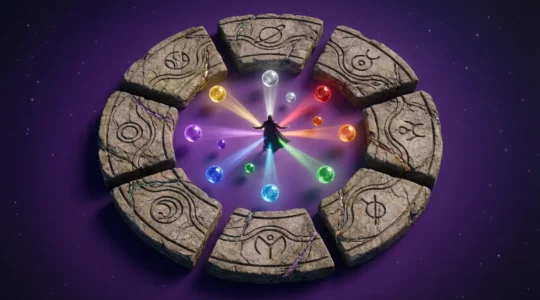
Ruling Planet by Weekday: How the Day of Your Birth Forged Your Fate
Many know the “Monday’s Child” rhyme, but few grasp the profound magical system it hides. The day you were born is not a simple personality trait; it is your natal imprint, a planetary current that dictates your innate strengths and…
Read more
Spiritual Protection 101: Shielding Your Energy Field Daily
In summary: Effective energy protection is a practical skill of “energetic hygiene,” not a fear-based reaction. Visualizing shields works because your focused intention has a measurable impact on your personal energy field. Proactive, daily shielding is far more efficient than…
Read more
Exploring Global Esoteric Traditions: From Hermeticism to Kabbalah
Genuine esoteric knowledge isn’t found in popular trends, but in the disciplined study of historical lineages and their structured systems. The core of Western magic lies not in spells, but in the philosophical principle of correspondence (“As Above, So Below”)….
Read more
How to Protect Your Union’s Harmony From External Envy?
Protecting your relationship is not about buying an evil eye charm; it’s about building an active, multi-layered energetic fortress. Your union creates a unique “third energy field” that is the primary target of envy, amplified by social media. True defense…
Read more
North Node vs. South Node: Charting Your Soul’s Karmic Compass
The persistent feeling of being pulled in two directions isn’t a flaw; it’s the core of your soul’s curriculum, encoded by your North and South Nodes. Your South Node represents mastered talents from past lives—your comfort zone, but also your…
Read more
Restoring Cosmic Balance in an Unequal Relationship
Contrary to common belief, a karmic imbalance in your relationship is not a life sentence of unfairness; it is a spiritual curriculum designed to teach you how to reclaim your power. One-sided relationships create karmic debt by disrupting the universal…
Read more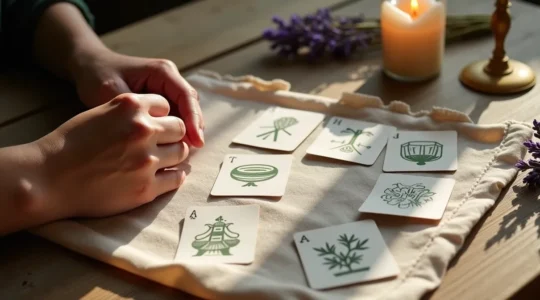
Why the Tarot de Marseille Remains the Most Accurate for Beginners?
The non-illustrated pip cards of the Tarot de Marseille are not a barrier for beginners, but a deliberate feature that creates a more accurate and deeply intuitive reader. This system forces a “grammar-based” learning approach, teaching you the language of…
Read more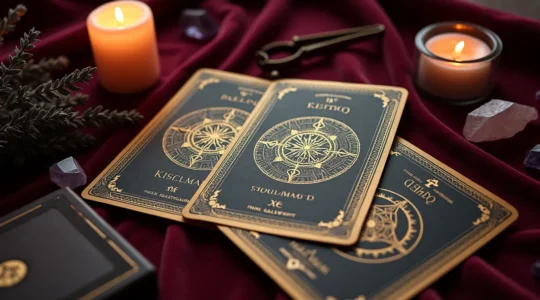
Major Arcana Analysis: Decoding the Symbolic Architecture of a Soulmate Connection
Contrary to popular belief, identifying a soulmate connection in the Tarot is not about spotting a single “destiny” card but about interpreting a complex energetic blueprint. Cards like The Lovers often represent a critical, soul-defining choice rather than a guaranteed…
Read more