
In summary:
- Successful crystal gazing is not about staring hard, but about relaxing your eyes to induce a natural, visionary state.
- Proper lighting is crucial; use dim, indirect light (like candles placed behind you) to create a uniform field that encourages visions.
- Your mental and emotional state is paramount. A clear intention and a mind free from fear are essential for opening the third eye.
- Visions appear in stages, often beginning as mists or clouds before resolving into clear images and symbols after 5-10 minutes.
The desire to peer beyond the veil, to glimpse the currents of fate or the whispers of the subconscious, is an ancient one. For aspiring seers, the crystal ball stands as a potent and iconic gateway to this other-sight. Many believe the key lies in finding the right magical artifact or possessing an innate “gift.” They spend hours staring intently into a quartz sphere, willing visions to appear, only to be met with frustration and eye strain. This common approach is rooted in a fundamental misunderstanding of the art.
While the quality of one’s tool and a meditative mind are indeed important, they are merely stage-setting. The true secret to scrying is not an act of force but of surrender. It is not a mystical power granted to a few, but a learnable, psycho-sensory skill. The core of this skill lies in moving beyond the error of “trying” to see and instead learning how to relax the visual cortex so profoundly that the brain itself begins to supply the images. This is the art of intentional Ganzfeld induction, a state where the physical eyes rest and the inner eye awakens.
This guide will illuminate the path from mundane sight to psychic vision. We will explore the subtle energies of different scrying tools, the precise environmental conditions required to quiet the analytical mind, and the critical techniques for softening your gaze. By understanding crystal gazing as a repeatable technique rather than an unpredictable miracle, you will learn to consciously open the portal to the internal landscape where visions await.
Summary: A Seer’s Path to Visions in the Crystal
- Why Quartz Spheres Amplify Psychic Visions?
- How to Light Your Room for Effective Crystal Gazing?
- Crystal Ball or Black Mirror: Which Scrying Tool is Easier?
- The Error of Staring Too Hard Instead of Softening Gaze
- When Do Visions Usually Appear During a Session?
- Why Subconscious Fear Shuts Down the Third Eye?
- Raw Stone or Tumbled Gem: Which Holds Purest Energy?
- How to Achieve Deep Meditative Focus for Psychic Work?
Why Quartz Spheres Amplify Psychic Visions?
The crystal sphere, particularly one of quartz, is not merely a prop; it is a finely tuned instrument of consciousness. Its power lies in its material structure and historical resonance. For centuries, seers have turned to these tools for their unique properties. The famous 16th-century occultist John Dee, an advisor to Queen Elizabeth I, used a crystal ball and an obsidian mirror for divination, believing they could reveal profound truths hidden from ordinary perception. His tools, now displayed in the British Museum, are a testament to the enduring legacy of crystallomancy.
Quartz-based minerals—such as Clear Quartz, Smoky Quartz, or Amethyst—are considered ideal for scrying because they are natural amplifiers of energy. Their crystalline lattice structure is said to capture, focus, and magnify the subtle psychic impressions of the user. Unlike opaque stones which limit your gaze to the surface, a translucent or transparent sphere invites your consciousness to travel into its depths. This internal landscape, with its natural fissures, fractures, and inclusions, becomes the canvas upon which visions are projected. When selecting a tool, the goal is to find a piece that you can see *into*, not just *at*.
To choose your first sphere, follow these principles:
- Prioritize Quartz-based Minerals: Their energy-amplifying nature is best suited for scrying work.
- Seek Translucency: You must be able to explore the sphere’s inner world. Opaque stones like Jasper are unsuitable for this method.
- Embrace Imperfections: Look for a sphere with an interesting inner landscape. The natural inclusions can act as focal points or morph into symbols during a session.
- Consider Size: Select a crystal ball large enough to gaze into without strain, allowing you to perceive its depths clearly.
How to Light Your Room for Effective Crystal Gazing?
The environment for scrying is as critical as the tool itself. A common misconception is that one needs complete darkness. The true aim is not the absence of light, but the creation of a uniform, non-distracting visual field. This is where the principles of the Ganzfeld effect come into play—a neurological phenomenon where the brain, deprived of changing sensory input, begins to generate its own imagery. Your goal is to create this “complete field” to encourage the third eye to open.
To achieve this, the room should be dimly lit, but the light source must be managed with precision. The key is to avoid any direct light entering your field of vision or reflecting off the surface of the crystal ball in a distracting way. This is why strategic candle placement is a time-honored tradition among seers. Placing one or two candles behind you or well off to the side creates a soft, ambient glow that illuminates the sphere without causing glare. This indirect lighting creates depth and shadow within the crystal, providing the perfect canvas for emerging visions. The atmosphere can be further enhanced with incense or essential oils to calm the mind and signal the beginning of a sacred practice.
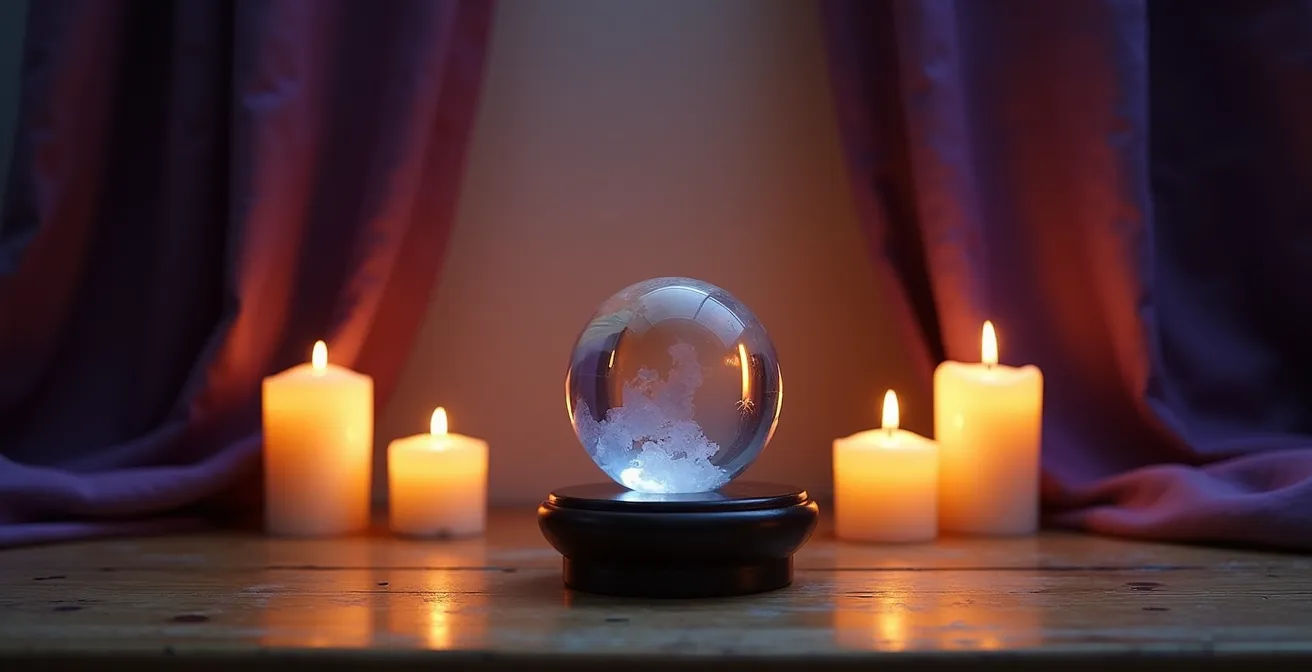
The setup shown above demonstrates this principle perfectly. The light is ambient and indirect, allowing the seer’s gaze to penetrate the sphere’s depths without being pulled to surface reflections. This controlled environment is not just for atmosphere; it is a practical technique for quieting the physical senses and awakening the psycho-sensory skill of clairvoyance.
Crystal Ball or Black Mirror: Which Scrying Tool is Easier?
While the quartz sphere is iconic, it is not the only portal available to the seer. Its reflective counterpart, the black mirror—often crafted from polished obsidian—is another potent tool with a long history in divination. Obsidian mirrors provide a gateway to the subconscious by reflecting the user’s own inner world back at them. The choice between a refractive crystal ball and a reflective black mirror often comes down to the seer’s natural psychic disposition: are they more inclined to projective or introspective vision?
A crystal ball, being refractive, bends light and draws the gaze inward, creating a three-dimensional space where cloudy, morphing images appear to form within the sphere. This is often better for projective scryers, those who feel information is coming *through* them from an external source. A black mirror, being reflective, presents a flatter, screen-like surface. It is excellent for inducing a hypnotic state and is often easier for beginners. It is ideal for introspective scryers, who use the tool to access their own deep knowledge and subconscious mind. If you are unsure, you can experiment with a bowl of dark water or even the screen of a turned-off smartphone to simulate the effect of a black mirror.
The following table breaks down the key differences to help guide your choice:
| Feature | Crystal Ball | Black Mirror (Obsidian) |
|---|---|---|
| Vision Type | Three-dimensional, cloudy, morphing images inside the ball | Flatter, screen-like images on the surface |
| Best For | Projective scryers (information coming through them) | Introspective scryers (accessing inner knowledge) |
| Material Nature | Refractive – bends light inward | Reflective – mirrors back |
| Learning Curve | Harder for beginners, greater depth when mastered | Easier for beginners, readily creates hypnotic state |
| Cost Option | Can be expensive for quality quartz | Test with smartphone screen (off) or dark water bowl first |
The Error of Staring Too Hard Instead of Softening Gaze
Here lies the greatest secret and the most common stumbling block in the art of scrying. The aspirant, eager for visions, fixes their eyes on the crystal and stares with intense concentration. This is a profound error. Forceful staring engages the analytical mind and tenses the optic nerve, effectively closing the very door you wish to open. True seeing comes not from effort, but from release. The goal is to achieve a state of visual relaxation where the focus softens and the boundary between eye and object dissolves.
As the experts at the Love & Light School of Crystal Therapy advise in their guide, one must learn to “gaze at the crystal and allow your eyes to go in and out of focus.” This is the essence of the technique. You are not looking *at* the surface, but looking *through* and *beyond* it. This soft, unfocused gaze allows the Ganzfeld effect to take hold, quieting the input from the physical world and inviting the subconscious to project its imagery onto the neutral field of the crystal.

The proper technique involves a state of relaxed awareness. Keep your eyes half-open and let your focus drift past the surface to a point somewhere in the center of the sphere, or even beyond it. Do not try to see; simply be open to what appears. The steps are as follows:
- Sit comfortably and concentrate without tensing your body.
- Open your eyes and gaze gently over the surface of your scrying tool.
- Shift your focus to a point somewhere beyond the physical surface.
- Allow your eyes to de-focus, as if daydreaming. Do not stare or hyperfocus.
- Keep initial sessions short, starting with just five minutes to build the muscle of visual relaxation.
When Do Visions Usually Appear During a Session?
Patience is a virtue for the aspiring seer. Visions do not typically appear instantaneously like flipping a switch. The process is a gradual unfolding, a slow parting of the mists. For those new to the practice, understanding the timeline and the stages of manifestation can prevent discouragement. The first signs are often subtle and can be easily dismissed if you don’t know what to look for. You are not waiting for a full-color movie to begin; you are watching for the first stirrings in the ether.
Generally, you can expect the first visual changes to occur within five to ten minutes of sustained, relaxed gazing. For many, beginners can expect initial visual changes after just 5 to 10 minutes of focused gazing. These are rarely clear images. The process typically unfolds in three stages. First, the interior of the crystal will appear to fill with a white, grey, or purplish mist or cloud. It may swirl or pulse. This is a sign that the connection is being established and your physical sight is giving way to your inner sight. It is crucial to maintain your soft gaze and not get excited or try to force the mist into a shape.
The second stage involves the mist beginning to coalesce. You might see dark blobs, pulsing spots, or shifting patterns. Continue to gaze with passive attention. In the third and final stage, these forms will start to resolve into coherent shapes, symbols, faces, or even full scenes. These images will flood into your third eye, sometimes appearing inside the ball and other times appearing directly in your mind’s eye. The key is to remain a detached observer throughout the process, allowing the visions to form and fade without judgment.
Why Subconscious Fear Shuts Down the Third Eye?
The most pristine crystal and the most perfect technique will fail if the scryer’s mind is a vessel of fear or negativity. The third eye is exquisitely sensitive to our inner state. Subconscious fears—fear of what you might see, fear of failure, or fear of the unknown—act like a vise, clamping shut the very psychic centers you are trying to open. Divination is not a parlor game; it is a sacred act. Approaching it with a scattered, anxious, or negative mindset not only blocks visions but can also attract confusing or distressing energies.
As the Love & Light School wisely counsels, “If you are not serious about the reading, or if you are in a negative state of mind, you should not use your crystal ball.” This is a fundamental law of psychic work. Your intention sets the frequency of your session. Before you even sit down to gaze, you must cultivate a state of mental clarity and emotional equilibrium. The work is best done when you are calm, centered, and approaching the oracle with respect and a clear, positive purpose. A protective ritual or visualization can be a powerful way to seal your space and your mind from unwanted influences.
A mental preparation protocol is essential for overcoming these internal blocks:
- Set a Clear Intention: Before you begin, state your purpose for the session. Intend that the reading be for the highest good of all.
- Create a Sacred Space: Ensure the area is clean, quiet, and free from distractions that could interrupt your meditative state.
- Practice Grounding: Perform a brief grounding exercise, such as visualizing roots growing from your feet into the earth, to stabilize your energy.
- Build Confidence: Start with shorter, five-minute sessions to build your comfort level and confidence in the process.
- Use Protection: Visualize a sphere of protective white or golden light surrounding you and your space before you begin to gaze.
Raw Stone or Tumbled Gem: Which Holds Purest Energy?
The form of a crystal has a profound impact on its energetic signature. Beyond the iconic polished sphere, scryers can also work with raw, unpolished stones or naturally formed “Seer Stones.” The choice between a perfectly smooth, tumbled gem and a wild, raw crystal depends on the nature of the work you intend to do. Neither is inherently “better,” but their energies are distinct. A polished sphere has a cultivated, harmonized energy, smoothed and focused by human hands. A raw crystal retains a wild, potent, and sometimes chaotic energy, tied directly to the earth from which it came.
Raw crystals are often preferred for earth-based magic, connecting with nature spirits, or ancestral work. Their untamed energy can be less predictable but more powerful for certain applications. Polished spheres and tumbled stones are generally more receptive to programming with specific intentions and are excellent for personal development, relationship questions, or healing work. Their smooth surface also provides a more uniform field for gazing, which can be easier for beginners. A special category exists in Seer Stones (also known as River Bed Quartz or Dragon Eggs). These are stones that are lightly tumbled and then sand-blasted to create a foggy exterior with a single polished “window,” offering a focused portal that combines both raw and polished qualities.
This table outlines the energetic differences:
| Aspect | Raw Crystal | Tumbled/Polished |
|---|---|---|
| Energy Signature | Wild, potent, chaotic | Cultivated, smoothed, harmonized |
| Best Use Cases | Earth-based magic, ancestral connections | Personal development, relationships |
| Clarity | Natural inclusions and fractures | Clear, uniform surface |
| Price | Generally lower | Higher for perfect clarity |
| Programmability | Less receptive, more unpredictable | More receptive to specific intentions |
Key Takeaways
- Scrying is a learnable skill of visual relaxation, not forced staring. The goal is to let go of effort to allow visions to arise naturally.
- The right lighting is a technical requirement, not just ambiance. Use dim, indirect light to create a uniform visual field that helps induce a visionary state.
- Your internal state is paramount. A clear, positive intention and a mind free from fear are as crucial as the physical scrying tool you choose.
How to Achieve Deep Meditative Focus for Psychic Work?
All the preceding elements—the right tool, the proper lighting, and a clear mind—culminate in this final, active step: achieving the state of deep meditative focus required for the inner eye to open. This is not a passive waiting but a structured process of attunement. The goal is to merge your consciousness with the crystal, transforming it from an external object into an extension of your own mind. This is where the Ganzfeld effect is consciously applied. By holding a relaxed gaze upon the uniform field of the crystal, you are giving your physical eyes nothing to process, which in turn signals the brain’s visual cortex to switch from external perception to internal generation.
This meditative state allows you to harness this natural neurological phenomenon for divination. You are intentionally creating the conditions for your brain to produce images, and by holding a clear question or intention, you guide the nature of those images. The crystal becomes the screen for the subconscious. The following protocol provides a clear, step-by-step method for entering this receptive state and initiating a scrying session. It combines physical relaxation, energetic connection, and focused intention to create the ideal conditions for psychic work.
Your Action Plan: 5-Step Meditation Protocol for Crystal Gazing
- Positioning: Place your crystal ball in front of you on a stand and sit at a comfortable distance. Ensure your posture is relaxed but upright.
- Breath Focus: Close your eyes for a moment. Relax your body and mind by focusing on your breath, inhaling calm and exhaling tension for a couple of minutes.
- Energetic Connection: Open your eyes and, if you feel called, place your hands on or around the crystal ball. Focus on sending your energy and your question into the stone.
- Sustain the Link: Maintain this conscious connection for at least another minute or two, feeling the boundary between you and the crystal begin to blur.
- Initiate the Gaze: Remove your hands and begin the soft, unfocused gaze as previously described, holding your question gently in your mind as you look into the crystal’s depths.
With the path laid bare, the only remaining step is to walk it. The art of seeing is cultivated through practice, patience, and reverence. Begin by acquiring your chosen tool, preparing your sacred space, and dedicating a quiet time to this ancient work. The visions are waiting.