Clairvoyance & Divination
Clairvoyance and divination represent humanity’s timeless pursuit of accessing information beyond ordinary perception. Unlike casual fortune-telling, these practices constitute structured methods for developing intuitive awareness and interpreting symbolic guidance. Whether you’re drawn to the visual poetry of oracle cards, the mathematical precision of numerology, or the focused concentration of scrying, each modality offers a unique pathway to insight.
The landscape of divination is remarkably diverse, encompassing everything from ancient cartomancy systems to energy-reading techniques that require no tools at all. This comprehensive exploration introduces the foundational methods practiced today, examining their core principles, practical applications, and the critical distinctions that separate genuine skill development from common misconceptions. You’ll discover how different systems complement each other and which approach might resonate most strongly with your natural inclinations.
Understanding Intuition and Energy Reading
Before reaching for any divination tool, developing your innate intuitive capacity provides the essential foundation. Energy reading—the ability to perceive subtle shifts in emotional or energetic atmospheres—represents one of the most immediate yet frequently misunderstood clairvoyant skills.
Recognizing Subtle Energy Shifts
Authentic energy perception typically manifests as physical sensations rather than dramatic visions. Practitioners often describe experiencing temperature changes, pressure in specific body areas, or unexplained emotional waves when entering certain environments or interacting with particular individuals. For instance, someone attuned to energy shifts might notice a sudden heaviness in their chest when a partner is withholding information, or an inexplicable lightness when entering a space where positive events recently occurred.
Reading auras—the electromagnetic fields surrounding living beings—extends this sensitivity further. While popular culture depicts auras as vivid rainbow halos, most people initially perceive them as faint color impressions in their peripheral vision or as intuitive knowing about someone’s emotional state. Specific colors traditionally correlate with distinct energetic qualities: murky browns or grays might suggest deception or illness, while clear blues indicate calm communication.
Distinguishing True Intuition from Anxiety
The most critical skill in energy work involves separating genuine intuitive signals from projection and paranoia. This distinction proves especially challenging in emotionally charged situations like romantic relationships. Authentic intuition typically arrives as calm, neutral information—a quiet certainty rather than anxious rumination. It often includes specific details you couldn’t have consciously known and doesn’t escalate with repeated mental examination.
Anxiety-driven suspicion, conversely, intensifies through focus, creates circular thought patterns, and stems from fear rather than neutral observation. The error of confronting others based on ungrounded hunches damages relationships and undermines your confidence in genuine intuitive hits. Effective practitioners establish grounding practices—such as optimizing clarity through dream interpretation or seeking confirmation through multiple divination methods—before acting on energetic impressions.
Card-Based Divination Systems
Cartomancy transforms abstract questions into concrete visual narratives through symbolic card imagery. The two dominant contemporary systems—oracle cards and Lenormand cards—serve distinctly different purposes despite superficial similarities.
Oracle Cards for Personal Guidance
Oracle decks offer thematic flexibility and intuitive accessibility, making them ideal entry points for beginners. Unlike the fixed structure of traditional tarot, oracle systems vary widely in card count, imagery, and interpretive frameworks. A love-focused oracle deck, for example, might contain cards specifically addressing relationship stages, emotional patterns, and romantic archetypes.
The primary strength of oracle divination lies in its emphasis on personal resonance over memorized meanings. When performing a spread for new love, the images themselves trigger intuitive responses that contextualize the guidebook definitions. However, this subjectivity creates a common pitfall: misinterpreting positive cards by projecting desired outcomes rather than receiving the actual message. A card depicting union might indicate internal integration rather than external partnership.
Optimizing question phrasing dramatically improves oracle accuracy. Effective questions are:
- Open-ended rather than yes/no: “What energy surrounds my career transition?” versus “Will I get the job?”
- Focused on understanding rather than prediction: “What do I need to know about this relationship?” versus “When will we get engaged?”
- Empowering rather than passive: “How can I navigate this challenge?” versus “What will happen to me?”
Lenormand Cartomancy for Precise Predictions
Lenormand represents a systematic predictive approach fundamentally different from oracle work. This 36-card system employs concrete, everyday symbols—ship, ring, fox, house—that combine in pairs to create specific, literal meanings. Where oracle cards explore psychological landscapes, Lenormand describes external events and timing with remarkable directness.
The Grand Tableau method arranges all 36 cards in a grid, creating a comprehensive life snapshot covering multiple areas simultaneously. Reading Lenormand requires understanding pair combinations: Ship + Ring might indicate a committed relationship involving distance or travel, while Fox + Ring suggests a deceptive partnership or work contract requiring scrutiny.
The most frequent context error occurs when readers approach Lenormand with oracle or tarot interpretive styles, seeking symbolic or psychological depth in inherently literal symbols. The Bird card typically indicates communication, gossip, or anxiety—not spiritual freedom or transcendence. Optimizing Lenormand accuracy demands accepting its concrete nature and developing fluency in the grammar of card combinations rather than forcing nuanced emotional readings.
Visual Divination Through Scrying
Scrying—sustained gazing into reflective or translucent surfaces to receive visions—represents one of divination’s oldest techniques. Though often dismissed as theatrical, the practice involves genuine perceptual and neurological phenomena that produce measurable results.
Tools and Setup Requirements
The physics of scrying relies on optical conditions that induce a mild trance state. Crystal balls, black mirrors, water bowls, and even flame all create focal points that, when gazed at with soft focus in appropriate lighting, trigger the brain’s pattern-recognition systems. Low, indirect lighting proves essential—harsh illumination prevents the subtle visual shifts that characterize scrying visions.
Crystal balls versus mirrors offer different experiential qualities. Spheres create three-dimensional depth that some practitioners find more immersive, while flat mirrors (especially black obsidian) provide clearer two-dimensional imagery. Neither proves inherently superior; the choice depends on personal visual processing preferences. Setting the environment includes:
- Eliminating external distractions and establishing comfortable seating
- Positioning the scrying tool at a natural viewing angle without neck strain
- Using candles or dim lamps positioned behind or to the side of your viewing position
- Establishing a clear question or intention before beginning the session
Common Pitfalls to Avoid
Eye strain risks constitute the most immediate concern in scrying work. Sessions exceeding 15-20 minutes, especially for beginners, can cause headaches, blurred vision, and temporary visual disturbances. These physical symptoms don’t indicate spiritual breakthrough—they signal genuine optical fatigue requiring rest.
Timing the visions appropriately means recognizing that authentic scrying impressions typically emerge within the first 10-15 minutes or not at all in a given session. Forcing extended practice creates fatigue-induced hallucinations rather than genuine clairvoyant perception. The images themselves often appear as fleeting impressions—shadowy forms, color shifts, or symbolic flashes—rather than cinema-quality scenes. Learning to capture and interpret these subtle impressions without embellishing them develops with consistent, brief practice sessions.
Numerology as a Divination Tool
Numerology approaches divination through mathematical reduction, positing that numbers derived from names and birthdates reveal personality patterns, life purposes, and relationship dynamics. This system appeals to analytically-minded individuals seeking structured, reproducible methods.
Life Path and Core Numbers
The Life Path number—calculated by reducing your complete birthdate to a single digit—represents numerology’s foundational concept. Someone born on November 7, 1989 calculates: 1+1+7+1+9+8+9 = 36, then 3+6 = 9, yielding a Life Path 9. The reducing method applies to dates, while names use letter-to-number conversion (A=1, B=2, etc.) to generate Expression, Soul Urge, and Personality numbers.
Each number from 1 to 9 carries distinct interpretive meanings. Life Path 4 individuals typically value structure, practicality, and systematic approaches, while Life Path 5 people seek variety, freedom, and experiential learning. The sharp contrast between LP 4 versus LP 5 illustrates how sequential numbers can represent fundamentally different orientations.
The master number myth—claiming that 11, 22, and 33 should never be reduced—creates unnecessary confusion. While these double digits do carry intensified energy, master number reduction still applies in most calculation contexts. The fatalism error occurs when people treat their Life Path as an unalterable destiny rather than a description of natural tendencies and optimal growth directions.
Relationship Compatibility Calculations
Calculating the pair involves comparing Life Path numbers, Expression numbers, or creating a combined couple number. A Life Path 3 (creative, expressive) and Life Path 8 (ambitious, material-focused) partnership faces different dynamics than a 2-2 pairing (both sensitive and partnership-oriented).
The challenge number—derived from the difference between specific core numbers—identifies friction points requiring conscious navigation. However, numerological compatibility serves best as a framework for understanding rather than a verdict on relationship viability. Optimizing strengths means using numerical insights to appreciate different operational styles rather than judging incompatibility.
Birthday numerology examines the specific day you were born (the 1st through 31st) as a distinct influence from the full Life Path. Double digits like 11, 22, or 29 within the birthdate carry layered meanings before reduction. Calculating the attitude number—derived from birth month and day only—reveals the social mask or outward presentation, creating yet another dimension of self-understanding.
Dowsing and Pendulum Work
Dowsing uses tools like pendulums or L-rods to access subconscious knowledge through physical movement. Though frequently associated with water-finding, pendulum divination addresses personal questions ranging from decision-making to gender prediction.
Understanding the Ideomotor Effect
The ideomotor effect—unconscious muscle movements triggered by thought—provides the mechanism behind pendulum function. Your hand makes imperceptible motions that set the pendulum swinging in response to mental focus, effectively translating subconscious information into observable movement. This isn’t deception; it’s a legitimate method of accessing knowledge below conscious awareness.
Recognizing this principle explains why bias interference poses the primary challenge in pendulum work. If you desperately want a specific answer, your ideomotor responses will likely reflect that desire rather than genuine insight. The needle and thread method—a simplified pendulum using household items—demonstrates that tool material (wood versus metal) matters less than the practitioner’s neutrality and clear calibration.
Calibration and Bias Management
General tool usage begins with calibrating the swing—establishing which movements indicate yes, no, and uncertain responses. Most practitioners ask verifiable questions: “Is my name [correct name]?” to establish yes, then “Is my name [incorrect name]?” for no. This process must occur at each session’s beginning, as your energy state influences response patterns.
The fatigue error mirrors scrying’s time limitations. Extended pendulum sessions produce increasingly unreliable answers as mental focus wavers and physical tiredness introduces erratic movements. Timing the check appropriately means limiting sessions to 10-15 questions and avoiding practice when emotionally activated or physically exhausted.
Optimizing charts—using printed templates with letters, numbers, or concept categories—extends pendulum capability beyond yes/no responses. The pendulum can spell names, select timing, or identify solutions from multiple options. However, the polarity concept reminds practitioners that some questions inherently lack yes/no answers, requiring reformulation for pendulum compatibility.
Across all divination modalities, the common thread involves developing sensitivity—to symbols, numbers, energy, or subconscious signals—while maintaining the discernment to distinguish genuine perception from wishful projection. Whether you’re drawn to the tactile simplicity of pendulum work or the complex symbolic language of Lenormand, consistent practice with honest self-assessment builds practical clairvoyant skill that serves real-world decision-making.

The Art of Dowsing: How to Calibrate Your Pendulum for Accurate Yes/No Answers
Getting reliable answers from a pendulum isn’t about magic, but about mastering the ideomotor response—the physical expression of your subconscious knowledge. Key steps include correctly programming its signals for “Yes” and “No”, choosing a material that resonates with your energy,…
Read more
Radionics Pendulum for Pregnancy: Can You Predict the Gender?
The accuracy of a pendulum gender reading has less to do with the pendulum itself and more to do with your ability to achieve energetic neutrality. The pendulum’s movement is an ideomotor response—a physical manifestation of your subconscious thoughts and…
Read more
Calculating Life Path Based on Full Date Numbers: The Ultimate Guide
The accuracy of your Life Path number depends entirely on the calculation method; using simple addition often leads to incorrect results and a misunderstanding of your core spiritual curriculum. Your birth date must be broken into three separate units (Day,…
Read more
What Your Day of Birth Reveals About Your Inner Character?
Your numerological identity is a dynamic system: your Birth Day is the innate ‘hardware’ you are born with, while your Life Path and Name are the ‘software’ you run on it. The single digit of your birth day (e.g., the…
Read more
Numerology and Relationship Paths: Calculating Your Love Compatibility
True numerological compatibility isn’t found by simply matching Life Path numbers; it’s revealed by decoding the relationship’s unique energetic contract. Your partnership creates a third entity with its own “Composite Number” that defines its core purpose. Areas of “incompatibility” are…
Read more
Crystal Gazing Divination: How to See Visions in the Sphere?
In summary: Successful crystal gazing is not about staring hard, but about relaxing your eyes to induce a natural, visionary state. Proper lighting is crucial; use dim, indirect light (like candles placed behind you) to create a uniform field that…
Read more
Little Lenormand Spreads: How to Get Specific Answers Quickly?
The key to fast, specific Lenormand answers isn’t learning more spreads; it’s mastering the grammatical system that makes the cards talk. Unlike Tarot’s psychological archetypes, Lenormand uses a concrete vocabulary of nouns, verbs, and adjectives to build factual predictive sentences….
Read more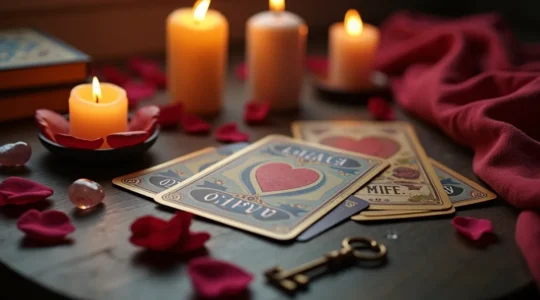
How Does the Cupid Oracle Reveal Your Romantic Future with Such Accuracy?
The Cupid Oracle’s true accuracy lies not in predicting a fixed future, but in diagnosing the emotional and energetic patterns shaping your love life right now. Unlike general Tarot, Love Oracles provide direct, focused messages about romantic dynamics, offering immediate…
Read more
How to Use Intuition to Detect Betrayal Before It Happens?
That nagging suspicion your partner is cheating isn’t just random anxiety; it’s your energetic system detecting a verifiable data disturbance. Betrayal creates a tangible energetic shift long before physical evidence appears. This guide moves beyond vague “gut feelings” to teach…
Read moreHow to Read Someone’s Mind
Can you read my mind? Reading one’s mind probably ranks among the highest in people’s list of powers that they would like to have, along with being invisible perhaps. Thus, many would like to know how to read someone’s mind….
Read more